






Product reviews
Aerify Lymphatic Drainage Boots – Complete Guide to Models and Use

Jun
Aerify and its compression recovery products
Aerify is a Latvian recovery technology brand offering pneumatic compression and cryocompression equipment for sport, recovery and home use.
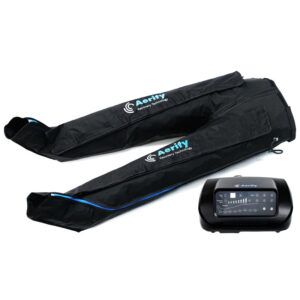
Aerify compression boots use pneumatic pressure to rhythmically compress the legs. Depending on the model, the system consists of several air chambers that inflate in different sequences and at adjustable pressure levels.
The current Aerify compression range includes several systems designed for different needs: Aerify Standard, Aerify Charge, Aerify Lite and the fully wireless Aerify Alphas. The range also includes other recovery products such as Aerify FLY calf compression sleeves and the Aerify Cryoboots X cryocompression system.
This guide focuses specifically on Aerify pneumatic compression boots: how they work, who may benefit from them, how the models differ and how to use them safely.
What are Aerify lymphatic drainage boots and how do they work?
Aerify boots are pneumatic compression boots, often referred to as lymphatic drainage boots or recovery boots. They contain several air chambers that inflate and release according to a selected programme, creating controlled external pressure around the legs.
Depending on the programme, compression may progress from the feet towards the thighs or involve several chambers simultaneously. This produces a rhythmic massage-like sensation and mechanically compresses the soft tissues of the legs.
Intermittent pneumatic compression has been used in medicine for many years in selected situations involving venous circulation, lymphatic conditions and swelling. More recently, similar technology has become popular among athletes and active people as a convenient recovery method.
For a home user, one of the main advantages is convenience. The boots can be used while sitting or lying down, for example while reading, watching television or relaxing after a long working day or training session.
Who may find Aerify compression boots useful?
Pneumatic compression boots are used by a wide range of people. They may be considered by:
- athletes after intensive training or competition;
- runners, cyclists, football players and strength-training athletes;
- people who spend many hours standing during the working day;
- people who sit for prolonged periods and experience heavy or tired legs;
- people looking for a passive relaxation and recovery method;
- some people with leg swelling when compression has been considered appropriate by a healthcare professional;
- physiotherapy clinics, sports clubs and recovery facilities.
In sport, the main reason for using pneumatic compression is often the subjective recovery effect. After a demanding session, some athletes report that their legs feel lighter, less stiff or more relaxed.
However, compression boots should be considered an additional recovery tool, not a replacement for appropriate training load management, sleep, nutrition, active recovery and rehabilitation when an injury is present.
What are the realistic benefits of compression boots?
Pneumatic compression mechanically compresses the tissues and may influence venous return and fluid movement within the legs. Depending on the person’s condition and reason for use, this may help with:
- reducing the subjective sensation of heavy or tired legs;
- providing a relaxing massage-like effect after physical activity;
- supporting movement of fluid within the tissues;
- helping manage certain types of leg swelling when compression is appropriate;
- improving the subjective feeling of recovery after exercise;
- providing a convenient passive recovery method at home or in a sports environment.
It is important to keep expectations realistic. Compression boots do not literally “flush toxins” from the body, and delayed muscle soreness is not caused by lactic acid remaining in the muscles for several days.
Likewise, using compression boots does not automatically prevent injuries or improve sporting performance. Research on intermittent pneumatic compression after exercise has produced mixed results. For many athletes, the main benefit is improved comfort and a subjective feeling of recovery rather than a guaranteed improvement in objective performance measures.
Why choose Aerify compression boots?
One of the main differences between Aerify models is the number of air chambers, pressure range, portability and the available control options.
Aerify Standard and Aerify Charge use 8 air chambers. More chambers allow the leg to be divided into smaller compression zones and provide greater flexibility when different compression sequences are used.
Aerify Lite is a simpler 4-chamber system intended for users who want full-leg pneumatic compression without the additional portability and control options of the more advanced models.
Aerify Alphas take a different approach. They use integrated pumps directly on the boots, eliminating the external control unit and air tubes. This makes them especially convenient for travel and mobile use.
Which Aerify compression system should you choose?
| Model | Air chambers | Maximum pressure | Power / portability | Best suited for |
|---|---|---|---|---|
| Aerify Standard | 8 | Up to 240 mmHg | Plug-in system | Regular home, clinic or sports-club use |
| Aerify Charge | 8 | Up to 240 mmHg | Rechargeable and portable | Frequent use, athletes, travel and sports teams |
| Aerify Lite | 4 | Up to 240 mmHg | Plug-in system | Entry-level full-leg compression and home use |
| Aerify Alphas | 5 | Up to 150 mmHg | Fully wireless with integrated pumps | Travel, convenience and mobile recovery |
The best model is therefore not necessarily the one with the highest maximum pressure. Someone who mainly wants easy recovery at home may be perfectly satisfied with Lite or Standard, while an athlete who travels frequently may value the portability of Charge or Alphas more highly.
For a broader comparison of compression-boot technology, see our article Compression Boots – How They Work, Benefits and How to Choose.
Are 8 air chambers better than 4?
A larger number of chambers divides the leg into more individual compression zones. This allows a more gradual compression sequence and greater flexibility when different chambers are activated or deactivated.
This can be particularly useful with full-body accessories such as compression trousers, shorts, arm sleeves or waist/back applicators.
However, the number of chambers alone does not determine whether a device is suitable for a particular person. Comfort, fit, programme design, pressure range, intended use and portability are also important.
A four- or five-chamber system may be entirely sufficient for someone who mainly wants a simple compression session after training or a long working day.
Does higher pressure mean better recovery?
No. The highest available pressure is not automatically the best or most effective setting.
The appropriate compression level depends on several factors:
- leg circumference;
- the specific Aerify model;
- the programme being used;
- session duration;
- individual sensitivity and tolerance;
- the reason for using compression.
For the first session, it is generally sensible to begin with a lower or moderate pressure and assess how the legs respond. The sensation should be firm but comfortable.
If compression causes pain, numbness, tingling, marked skin colour changes or significant discomfort, the pressure should be reduced or the session stopped.
Compression programmes
Aerify systems offer different compression patterns depending on the model. Some programmes create a sequential wave from the lower leg upwards, while others compress multiple chambers or combine different patterns.
For example, Aerify Standard provides several recovery modes that can be selected depending on the preferred sensation and purpose of the session.

Sequential compression
The chambers inflate progressively along the leg. This is one of the most commonly used patterns when the aim is a gradual massage-like compression effect.
Wave-style compression
Individual or grouped chambers inflate and release in sequence, creating a moving compression sensation along the leg.
Simultaneous compression
Several chambers may remain inflated together before releasing. This creates a different and often more intensive sensation compared with a simple sequential programme.
The exact programmes and controls differ between Aerify models, so the device-specific instructions should always be followed.

Pressure settings
Aerify models differ in how their pressure levels are adjusted. Standard and Charge provide more detailed pressure-control options, while Lite uses a simpler adjustment system. Wireless Alphas have their own integrated controls and can also be used with compatible mobile-app functions.
The important point is that more pressure is not automatically better. Start conservatively and increase the pressure only if the compression remains comfortable.
For sports recovery, the aim is usually not to tolerate the maximum possible pressure. A comfortable session that can be repeated consistently is generally more useful than an unnecessarily aggressive setting.

Selecting individual air chambers
On compatible Aerify systems, individual air chambers can be activated or deactivated. This makes it possible to reduce compression over a particularly sensitive area or modify which parts of the applicator are involved in the programme.
This feature can be useful when one region feels uncomfortable or when the user prefers to concentrate the compression sensation on selected parts of the leg.
However, after an injury or operation, chambers should not simply be switched off or increased according to guesswork. If there are medical restrictions or significant swelling, the appropriate use of compression should be discussed with the treating specialist.

How long should you use Aerify compression boots?
For general recovery, a session of approximately 20–30 minutes is a practical starting point for many users.
Longer sessions are not necessarily better. The appropriate duration depends on the pressure, programme, individual tolerance and reason for using the boots.
Before training, some athletes use a relatively short low-to-moderate compression session as part of their preparation. However, compression boots are not a substitute for an active warm-up. After using the boots, the athlete should still perform progressive movement, running, mobility or sport-specific exercises before high-intensity activity.
After training, compression is more commonly used as a relaxation or recovery method. The session should remain comfortable throughout.
Can compression boots be used every day?
For a healthy person using the boots for general recovery, regular use may be well tolerated. However, there is no requirement to use them every day, and more frequent use does not automatically produce better recovery.
The frequency should depend on the person’s training schedule, symptoms, pressure level and individual response.
If compression is being used specifically to manage persistent swelling, lymphoedema, venous disease or after a medical procedure, the appropriate frequency and pressure should be determined with a healthcare professional.
When should compression boots not be used without medical advice?
Pneumatic compression is not appropriate for every situation. Medical assessment is particularly important if there is:
- sudden unexplained swelling of one leg;
- suspected or known acute deep vein thrombosis;
- significant peripheral arterial disease or severely impaired circulation;
- severe or decompensated heart failure;
- an active skin or soft-tissue infection;
- significant loss of sensation or severe neuropathy;
- an open wound in the area covered by the boot;
- unexplained severe leg pain or rapidly increasing swelling.
If one leg suddenly becomes swollen, painful, warm or red, compression should not be used simply in an attempt to “massage the swelling away”. The cause should first be medically assessed.
Trying Aerify compression boots before buying
If you are unsure whether pneumatic compression is suitable for you or whether you will use the system regularly enough to justify buying one, trying or renting the equipment first can be a practical option.
For information about testing, availability or choosing a suitable system, contact us at info@fiziopreces.lv.
Should you buy or rent compression boots?
At Fiziopreces.lv, Aerify compression equipment can be purchased or rented. A wide range of Aerify products, accessories and replacement components is also available in our Aerify product section.
Buying a system makes the most sense if you expect to use it regularly over a longer period—for example, several times per week during training periods, in a physiotherapy clinic or as part of a sports team’s recovery setup.
Rental may be more suitable if you only need the system temporarily, want to use it during a particularly demanding training period or simply want to find out whether you like the sensation before purchasing your own device.
Current rental periods are:
- 3-day rental – €40
- 7-day rental – €80
- 14-day rental – €140
Review

Rinalds is a young football player who has been playing football for 10 years. His training sessions and matches take place around six times per week, sometimes with one or two sessions per day, which can be demanding and tiring.
According to Rinalds, his legs often feel very tired after training, so recovery between sessions is particularly important.
The compression session itself is relaxing – you put your legs into the boots and can simply rest for 30–40 minutes.
Related Articles
📖 When to Use Compression Boots – Before or After Training?
📖 6 Tips for Choosing the Right Massage Gun
📖 BLACKROLL Products – Foam Rollers, Massage Balls and Recovery Tools
Would a physiotherapist recommend Aerify compression boots?

Aigars Caune
Physiotherapist
Yes. From my own experience, Aerify boots are a practical and comfortable recovery tool. Pneumatic compression is also increasingly common in professional sport, particularly in environments where athletes need convenient recovery options between frequent training sessions and matches. I would not consider the boots a miracle solution or an essential part of recovery, but they can be a useful addition alongside appropriate training load management, sleep, nutrition and active recovery.
Recommended Compression Products


Lymphatic drainage
AERIFY STANDARD Lymphatic drainage system + pants + bag as a gift


Lymphatic drainage
AERIFY CHARGE Lymphatic drainage boot system + backpack as a gift


Lymphatic drainage

Equipment rental
More Product Reviews
Interested in learning more about physiotherapy and recovery products? Visit our Product Reviews section for practical articles about exercise equipment, compression therapy, self-massage tools and other physiotherapy products.
View Product Reviews