









Physiotherapist's recommendations
TENS vs EMS – What’s the Difference and Which Should You Choose?

Aug
When choosing an electrical stimulation device, product descriptions often include abbreviations such as TENS, EMS, NMES or STIM. At first glance, these may seem like similar programmes that simply differ in intensity, but in reality their primary purposes are quite different.
TENS is mainly used for temporary pain relief, while EMS or NMES is used to activate muscles and produce controlled muscle contractions. Therefore, the question is not which method is “stronger”, but rather which function is required in a particular situation.
If the only goal is symptomatic pain relief, a complex sports electrical stimulator may not be necessary. On the other hand, if a poorly functioning muscle needs to be activated after an injury or surgery, a simple TENS device will not adequately perform that task.
In this article, we will look at the difference between TENS and EMS, their applications in rehabilitation and sport, and the main criteria to consider when choosing an electrical stimulator.
What is TENS?
TENS stands for transcutaneous electrical nerve stimulation.
During the procedure, electrodes placed on the skin deliver electrical impulses that primarily stimulate sensory nerve fibres. The user usually feels a strong but comfortable tingling sensation. During a standard TENS pain-relief programme, a visible muscle contraction is not the main objective.
TENS can be used as an additional method for short-term pain control, for example to make it easier to move, exercise or perform rehabilitation tasks.
TENS:
- primarily influences the perception of pain;
- does not repair damaged tissues;
- is not intended to increase muscle strength;
- does not work equally well for everyone;
- should be used as part of a broader treatment or self-management plan.
For more information about how TENS works, treatment duration, intensity and safety, read our article TENS Procedure for Pain Relief.
What are EMS and NMES?
EMS stands for electrical muscle stimulation, while NMES stands for neuromuscular electrical stimulation.
In everyday product descriptions, these two terms are often used in a similar way. In clinical rehabilitation, NMES is generally the more precise term because the electrical impulse stimulates motor nerves and produces a controlled muscle contraction.
Depending on the manufacturer, this function may be labelled as:
- EMS;
- NMES;
- NMS;
- STIM;
- muscle stimulation;
- strength, resistance, endurance or rehabilitation programme.
For this reason, you should not choose an electrical stimulator based only on the name of a programme. It is more important to understand what the particular programme and device are designed to achieve.
During EMS/NMES, stimulation intensity is generally increased enough to produce a clearly visible and controlled contraction of the target muscle. It can be used for muscle activation, neuromuscular re-education or as an addition to strength rehabilitation.
TENS vs EMS – a quick comparison
| Criterion | TENS | EMS / NMES |
|---|---|---|
| Main purpose | Temporary reduction of pain perception | Muscle activation and contraction |
| Main stimulation target | Sensory nerve fibres | Motor nerves and muscle |
| Visible muscle contraction | Usually not required | Usually required |
| Sensation | Strong but comfortable tingling | Pulsing sensation and muscle contraction |
| Typical use | Pain symptom management | Muscle activation, rehabilitation and support for strength training |
| Electrode placement | Around the painful area | Over the target muscle and motor-point region |
| Does it replace exercise? | No | No |
When should you choose TENS?
A simple TENS device may be suitable when the main objective is management of pain symptoms and specific muscle stimulation is not required.
TENS may be considered if:
- the primary problem is pain rather than impaired muscle activation;
- you want a simple device for home use;
- you do not need sports or strength-stimulation programmes;
- TENS makes it easier to perform everyday activities or rehabilitation exercises;
- the cause of the pain is known and does not require other urgent medical treatment.
The 2022 meta-TENS systematic review analysed 381 randomised studies. Overall, sufficiently strong but comfortable TENS stimulation during or immediately after treatment was associated with lower pain intensity compared with placebo. However, this does not mean that TENS works equally well for every diagnosis or provides a long-term therapeutic effect.
In practice, TENS is best considered as a possible tool for symptom management rather than a treatment for the underlying cause of pain.
When should you choose EMS or NMES?
EMS/NMES becomes more relevant when the problem is not only pain but there is also a need to produce a contraction in a specific muscle.
In rehabilitation, NMES can be used, for example:
- when muscle activation is impaired;
- after surgery or prolonged immobilisation;
- as part of a muscle-strength recovery programme;
- for neuromuscular re-education;
- as an addition to active strength exercises;
- in selected sports-conditioning programmes.
A good example is quadriceps weakness following knee surgery. Systematic research suggests that NMES used in addition to conventional rehabilitation may improve quadriceps strength recovery, although the size and clinical relevance of the benefit varies between patients and treatment protocols.
Studies in healthy individuals have also reported increases in muscular strength following EMS training. However, the protocols used in these studies vary considerably, and there is no reason to consider electrical stimulation superior to well-designed strength training.
In rehabilitation, EMS/NMES works best as an addition to active exercise rather than as a replacement for it.
What should you choose if you have both pain and muscle weakness?
In this situation, a combined TENS + EMS/NMES device may be a practical choice.
For example, during one stage of rehabilitation a TENS programme may be used to help manage pain symptoms, while during a separate session an NMES programme can be used to activate a specific muscle.
It is important to understand that these two functions are not interchangeable. The fact that a device can produce a strong muscle contraction does not automatically make it a better TENS device, and vice versa.
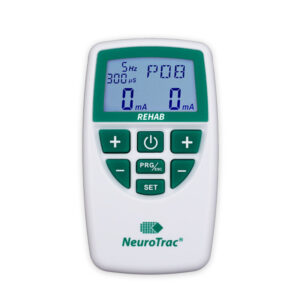
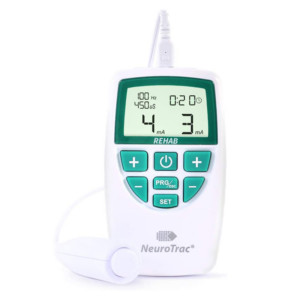
A good example from the Fiziopreces.lv range is NeuroTrac MultiTENS, which combines TENS and muscle-stimulation programmes, while NeuroTrac REHAB is more specifically oriented towards TENS and STIM use in rehabilitation.
How to choose an electrical stimulator
1. Start by identifying your main goal
This is the most important selection criterion.
| Main need | Most suitable device type |
|---|---|
| Pain symptom management only | TENS device |
| Pain + simple muscle stimulation | TENS + EMS/NMES device |
| Rehabilitation after injury or surgery | TENS + NMES/STIM with suitable rehabilitation programmes |
| Muscle activation and sports training | EMS/NMES-focused device |
| Clinic or professional rehabilitation | Professional multi-channel electrical stimulation system |
2. Check the number of channels
The number of channels determines how many pairs of electrodes can be used independently.
Two channels are sufficient for many home-use situations – for example, stimulating one muscle group or positioning four electrodes around a painful area.
Four channels become more useful when a larger muscular area, several muscle groups or professional applications need to be treated simultaneously.
More channels do not automatically mean a better device – a home user may simply never use the additional channels.
3. Preset or customisable programmes?
For home users, clear programmes prepared by the manufacturer are generally more convenient. Users do not necessarily need to change pulse frequency, pulse width or work/rest ratios themselves if they do not understand the significance of these parameters.
Customisable programmes are more useful for physiotherapists or experienced users who want to create a protocol tailored to a specific rehabilitation goal.
4. Home or professional use?
For simple home use, you do not necessarily need a clinic-level four-channel system with dozens of protocols.
For a physiotherapist, however, important features may include:
- several independent channels;
- wider adjustment of stimulation parameters;
- specific rehabilitation programmes;
- the ability to stimulate larger muscle groups simultaneously;
- additional technologies and professional functions.
The differences between professional models are explained in more detail in our article Chattanooga Rehab, Theta and Physio – A Comparison of Professional Electrostimulators.
5. Check electrode compatibility
The cost of electrical stimulation does not end with purchasing the device itself. Electrodes are consumable items and gradually lose their adhesion and conductivity.
Before choosing a device, check:
- the electrode connector type;
- available electrode sizes;
- the price and availability of replacement electrodes;
- whether larger electrodes can be used for larger muscle groups.
A worn or partially detached electrode can produce uneven stimulation and a sharper, less comfortable sensation.
Which device is suitable for different purposes?
NeuroTrac TENS – a simpler option when the main goal is TENS-based pain stimulation and muscle-strength programmes are not required.
NeuroTrac MultiTENS – suitable when both TENS and basic EMS/NMES functions are required in one device.
NeuroTrac REHAB – more rehabilitation-focused, combining TENS and STIM muscle-stimulation functions.
NeuroTrac SPORTS XL – more focused on muscle stimulation, sport, strength, muscle activation and recovery programmes.
For a detailed comparison of these models, see NeuroTrac Electrostimulators – Comparison of TENS, REHAB, MultiTENS, SPORTS XL and Continence.
Does having more programmes mean a better electrical stimulator?
No. The number of programmes is one of the easiest technical specifications to compare, so it is frequently emphasised in product marketing. In practice, however, the relevance of those programmes is more important.
If someone only needs TENS, a high-quality device with a few suitable TENS programmes may be a much more logical choice than an expensive electrical stimulator with dozens of sports programmes that will never be used.
Similarly, in rehabilitation, the following factors are more important than the number of programmes:
- whether the device can produce a sufficient contraction of the target muscle;
- whether the electrodes can be positioned correctly;
- whether the programme matches the rehabilitation goal;
- whether the user can adjust the intensity safely;
- whether stimulation is combined with appropriate active rehabilitation.
TENS and EMS electrode placement is also different
Even when using the same electrical stimulator, TENS and EMS electrodes may need to be positioned very differently on the same area of the body.
With TENS, electrodes are generally positioned so that stimulation surrounds or covers the painful area.
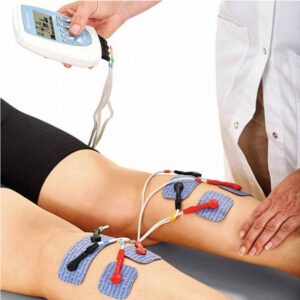
With EMS/NMES, electrodes are positioned over the muscle being stimulated, often with one electrode placed close to the motor point where a stronger muscle response can be produced using a lower stimulation intensity.
For example, when TENS is used for knee pain, electrodes may be positioned around the knee joint. For quadriceps NMES, however, the electrodes should be positioned over the muscles on the front of the thigh.
For practical placement examples for different areas of the body, see TENS and EMS Electrode Placement – A Practical Guide for Different Body Zones.
What should electrical stimulation feel like?
During TENS
You should generally feel:
- a clearly noticeable tingling sensation;
- strong but comfortable stimulation;
- an even sensation underneath and between the electrodes.
The stimulation should not feel burning or sharply painful. During a standard TENS programme, there is no need to produce a strong muscle contraction.
During EMS/NMES
The goal is generally:
- a visible contraction of the target muscle;
- controlled and tolerable stimulation;
- a contraction that engages the required muscle rather than producing only a small twitch directly underneath the electrode.
If the rehabilitation goal is muscle strength or activation, very low stimulation intensity that causes only mild tingling or minimal muscle twitching may be insufficient.
Electrical stimulation safety
TENS and EMS devices can differ in their programmes, parameters and contraindications, so always follow the instructions supplied with the specific device.
General safety principles include:
- place electrodes only on clean, intact skin;
- do not move electrodes while stimulation is switched on;
- reduce the intensity to zero before removing electrodes;
- do not create a current pathway across the chest;
- do not place electrodes on the front or side of the neck;
- do not place electrodes over open wounds or significantly irritated skin;
- stop the procedure if sharp pain, burning or significant skin irritation occurs.
If you have an implanted electronic medical device, are pregnant, have epilepsy, significant cardiac rhythm problems, substantial sensory impairment or another complex medical condition, check the contraindications for the specific device and consult an appropriate healthcare professional before using electrical stimulation.
Common mistakes when choosing TENS or EMS
Buying EMS only for pain relief
A muscle-stimulation programme is not the same as TENS. If the only objective is management of pain symptoms, a simpler TENS device may be sufficient.
Using TENS to strengthen muscles
A standard TENS programme is not designed to produce sufficiently strong and repeated muscle contractions to function as muscle-strength training.
Choosing a device only by the number of programmes
Having 20 or 30 programmes is not an advantage if you only need two or three specific functions.
Using EMS intensity that is too low
If the objective is muscle activation, mild tingling without a clear muscle contraction generally does not achieve the primary goal of NMES.
Incorrect electrode placement
A TENS electrode configuration around a painful joint is not appropriate when the goal is to stimulate a specific muscle. With EMS/NMES, the position should be selected so that stimulation effectively activates the target muscle.
Using worn electrodes
Dried-out or poorly adhering electrodes can produce unpleasant and uneven stimulation. They should be replaced when necessary.
Frequently asked questions about TENS and EMS
Is EMS stronger than TENS?
These methods should not really be compared as simply “stronger” or “weaker”. TENS primarily stimulates sensory nerve fibres, while EMS/NMES is designed to activate motor nerves and produce muscle contraction. They are intended for different purposes.
Can TENS strengthen muscles?
A standard TENS pain-relief programme is not designed to increase muscle strength. If the goal is muscle activation or strength rehabilitation, an appropriate EMS/NMES programme should be used.
Can EMS reduce pain?
Some combined devices include both muscle-stimulation programmes and programmes for pain relief or recovery. However, if pain modulation is the main goal, a dedicated TENS or other appropriate pain programme on the device should be selected rather than a random strength-stimulation programme.
Can TENS and EMS be used on the same day?
This may be possible, but the procedures should be adapted to the specific device, body area and rehabilitation goal. Always follow the manufacturer’s usage restrictions.
Can TENS be used every day?
Many TENS devices can be used regularly if permitted by the instructions and if the skin tolerates the electrodes well. However, treatment frequency and duration should be adapted according to the individual’s response and the manufacturer’s instructions.
Can an EMS strength programme be used every day?
Intensive NMES strength stimulation places a training load on the muscle, so there is no reason to automatically repeat a demanding strength programme every day. Training load and recovery should be planned similarly to other forms of strength training and adapted to the stage of rehabilitation.
Do I need two or four channels for home use?
For many local home treatments, a two-channel device is sufficient. Four-channel systems are more useful when stimulating larger muscle groups, several areas or when the device is used professionally.
Summary – TENS or EMS?
The main difference can be remembered very simply:
- TENS – mainly for temporary reduction of pain perception.
- EMS/NMES – mainly for muscle activation and producing muscle contraction.
If only pain symptom management is required, a simple TENS device is often sufficient. If rehabilitation also requires restoration of muscle activation or strength, a device with EMS/NMES functionality should be selected. For someone who needs both functions, a combined TENS + EMS/NMES device may be the most practical solution.
An electrical stimulator should not be chosen simply according to which model offers the greatest number of programmes. The best device is one whose functions match the intended goal and that the user can operate correctly and safely.
References
- Johnson MI, Paley CA, Jones G, Mulvey MR, Wittkopf PG. Efficacy and safety of transcutaneous electrical nerve stimulation (TENS) for acute and chronic pain in adults: a systematic review and meta-analysis of 381 studies (the meta-TENS study). BMJ Open. 2022;12:e051073.
- Nussbaum EL, Houghton P, Anthony J, Rennie S, Shay BL, Hoens AM. Neuromuscular Electrical Stimulation for Treatment of Muscle Impairment: Critical Review and Recommendations for Clinical Practice. Physiotherapy Canada. 2017;69(5):1–76.
- Peng L, Wang K, Zeng Y, et al. Effect of Neuromuscular Electrical Stimulation After Total Knee Arthroplasty: A Systematic Review and Meta-Analysis of Randomized Controlled Trials. Frontiers in Medicine. 2021;8:779019.
- Mukherjee S, Fok JR, van Mechelen W. Electrical Stimulation and Muscle Strength Gains in Healthy Adults: A Systematic Review. Journal of Strength and Conditioning Research. 2023;37(4):938–950.
Related Articles
📖 TENS Procedure for Pain Relief
📖 TENS and EMS Electrode Placement – A Practical Guide for Different Body Zones
📖 NeuroTrac Electrostimulators – Comparison of TENS, REHAB, MultiTENS, SPORTS XL and Continence
📖 Compex Electrostimulation Devices – Comparison of FIT and SP Models
If I have both pain and muscle weakness, is it better to choose a TENS + EMS device?

Aigars Caune
Physiotherapist
If the goal is only symptomatic pain relief, a simple TENS device is often completely sufficient. A combined TENS + EMS/NMES device becomes more useful when the rehabilitation programme also requires activation of a specific muscle or restoration of strength.
More programmes do not automatically mean a better choice – what matters most is that the functions of the device match the intended goal and that you know how to use them correctly and safely.
Recommended Products


Elektro stimulācija


Elektro stimulācija
Elektro stimulācija


Elektro stimulācija
Interested in more practical physiotherapist recommendations?
Explore our Physiotherapist’s Recommendations section, where you will find articles about pain management, rehabilitation, electrical stimulation, exercise and a safe return to everyday activities or sport.
View Physiotherapist Recommendations