






Physiotherapist's recommendations
When to Use Compression Boots – Before or After Training?

Aug
Compression boots can be used both before and after physical activity, but the purpose is different in each situation. Before training, they can be used as a short addition to the preparation routine, while after training they are more commonly used for relaxation, reducing the sensation of heavy legs and improving subjective recovery.
If you can use compression boots only once during the day, the most practical choice will usually be after training. Post-exercise use has been studied more extensively, and this is also when athletes are more likely to want to reduce leg fatigue and muscle soreness.
However, compression boots are not a miracle recovery method. They do not replace sleep, nutrition, hydration, appropriate load management or an active cool-down. Their main value is as an additional recovery tool that can be conveniently incorporated into a daily routine.
Short answer: before or after training?
Before training, compression boots can be used for a shorter period with light to moderate pressure if the athlete experiences heavy, stiff or tired legs. However, an active warm-up appropriate for the sport is still necessary afterwards.
After training, compression boots are generally used for longer. In this situation, their main purpose is to provide a relaxing compression effect, reduce the sensation of heavy legs and help the athlete subjectively feel better recovered.
If you have to choose only one time to use them, a post-training session will usually be the more practical option for most physically active people.
Compression boots before training
Before training, compression boots are most commonly used by athletes who arrive with a feeling of heaviness, stiffness or fatigue in the legs. This may be relevant after a match the previous day, an intensive strength session, a long journey or during periods of particularly high weekly training volume.
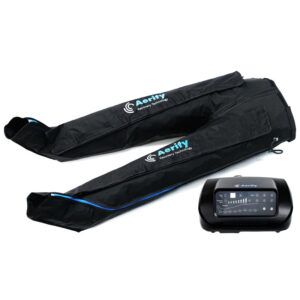
Sequential pneumatic compression alternately compresses and releases the tissues of the legs. The session can provide a pleasant massage-like sensation and may help the athlete mentally and physically transition towards the upcoming training session.
Compression boots themselves, however, are not a warm-up. While wearing the boots, the athlete is not moving, does not increase body temperature in the same way as during active exercise and does not prepare the neuromuscular system for sprinting, jumping, changes of direction or heavy strength work.
Therefore, after the compression session it is still necessary to perform:
- a gradual general warm-up;
- active joint movements;
- strength and mobility exercises appropriate for the sport;
- accelerations, jumps or other sport-specific movements when these are part of the upcoming training session.
How long should compression boots be used before training?
Before physical activity, approximately 10–15 minutes is usually sufficient. The session should feel comfortable, using light to moderate pressure.
There is no need to use the maximum pressure setting. An excessively intense session before training may cause an unpleasant feeling of pressure or make the legs temporarily feel unusual in some people.
A practical approach is to:
- choose light to moderate pressure;
- finish the session early enough to allow time for an active warm-up afterwards;
- avoid trying an unfamiliar programme for the first time immediately before an important match or competition;
- stop the session if pain, tingling or numbness develops.
When can using compression boots before training be useful?
Compression boots can be a practical addition before training:
- the day after an intensive match or competition;
- between two training sessions on the same day;
- after prolonged travel or sitting;
- during periods of high training volume;
- when the athlete subjectively feels that the legs are heavy or stiff;
- as part of an established pre-training routine.
If the legs already feel fresh and the athlete can complete a full active warm-up without difficulty, using compression boots before every training session is not necessary.
Compression boots after training
Compression boots are used more frequently after training than before exercise. The athlete can sit or lie down, relax the legs and, during the session, drink fluids, eat or simply rest.
This is one of their main practical advantages: the session does not require active effort and can easily be combined with other recovery activities.
Research on the effect of compression boots on objective recovery of strength, jumping ability or sports performance has produced inconsistent results. Some studies have found very small benefits or no meaningful effect, while potential benefits are more commonly seen in subjective outcomes such as reduced muscle soreness, fatigue or the sensation of heavy legs.
For this reason, compression boots are more accurately described as a comfortable recovery aid rather than a method that guarantees faster recovery of physical performance. [1–4]
How long should compression boots be used after training?
After exercise, a 20–30 minute session is commonly used in practice. In a 2024 systematic review and meta-analysis, sessions lasting approximately 20–30 minutes with pressures around 80 mmHg were among the most frequently used protocols.
However, devices, pressure scales and individual tolerance vary, so these numbers should not be viewed as a universal prescription. [1]
The pressure should be sufficient to produce noticeable sequential compression, but the procedure should not be painful. There is no convincing evidence that using the highest possible pressure leads to better sports recovery.
A good starting approach is to:
- choose moderate pressure;
- start with 20–30 minutes;
- assess how the session feels while using the boots;
- evaluate how the legs feel afterwards and the following day;
- only then adjust the pressure or session duration if necessary.
Compression boots do not have to be put on immediately after finishing training. You can first complete your cool-down, change clothes, rehydrate and eat. The compression session can be performed later the same day or in the evening if that fits your routine better.
Comparison: before and after training
| When used | Main purpose | Suggested duration | Pressure | Main limitation |
|---|---|---|---|---|
| Before training | Reduce the subjective feeling of heaviness or stiffness and prepare for activity | Approximately 10–15 minutes | Light to moderate | Does not replace an active warm-up |
| After training | Relaxation and reducing the sensation of heavy legs or subjective muscle soreness | Approximately 20–30 minutes | Moderate and comfortable | Does not guarantee faster recovery of strength or sports performance |
| Between two training sessions | Recovery after the first session and preparation for the next | Approximately 15–25 minutes | Light to moderate | Time must still be available for eating, hydration and an active warm-up |
| On a rest day | Reduce the sensation of heavy or tired legs | Approximately 20–30 minutes | According to individual tolerance | Not necessary if the legs already feel good |
If you have two training sessions on the same day
If there are several hours between two training sessions, the most logical time to use compression boots is after the first session rather than immediately before the second.
For example, after morning training you could use the boots for 15–25 minutes, then rehydrate, eat and rest. Before the evening session, a complete active warm-up is still necessary.
If very little time is available between sessions, priority should be given to:
- rehydration;
- an appropriate meal or snack;
- changing clothes and having time to rest;
- preparing for the next training session.
In this situation, compression therapy is only an additional recovery option. It should not take away time from more important recovery priorities.
When to use compression boots after strength training
After a demanding lower-body strength session, compression boots can be used later the same evening, particularly when another training session is planned for the following day.
The procedure may feel pleasant after squats, lunges, deadlift variations or a high volume of eccentric exercise. However, it cannot prevent all delayed-onset muscle soreness and does not remove the need to manage training volume appropriately.
If very pronounced muscle soreness persists for several days after every lower-body training session, the training load should be evaluated first rather than simply increasing the intensity of the compression session.
When to use compression boots after running or cycling
After longer runs, interval sessions or cycling, compression boots can be used after cooling down and rehydrating.
Endurance athletes often appreciate them as a passive recovery method because the legs do not need to perform any additional work during the session.
However, the available research does not demonstrate that compression boots consistently improve performance in the next training session or prevent exercise-induced muscle damage. The potential benefit is more often a short-term improvement in subjective recovery and comfort. [1–3]
When to use compression boots after football, basketball or another team sport?
After a match, an athlete may experience not only general fatigue but also local muscle soreness caused by impacts, rapid decelerations, sprinting and changes of direction.
Compression boots can be used later that evening after the athlete has eaten and rehydrated. In practice, a session often lasts approximately 20–30 minutes.
Even in professional sport, however, compression boots should not be viewed as an essential or decisive recovery method. A recent randomised study involving international-level youth football players found that a single high-pressure intermittent pneumatic compression session after a match did not improve neuromuscular, biochemical or perceptual recovery measures compared with placebo. [4]
Read more about how recovery methods are used in a professional team in our article “How Do Professional Athletes Recover Between Matches?”.
Do compression boots “remove lactic acid and toxins”?
The effects of compression boots should not be explained as “removing toxins”. This is an overly simplified and misleading explanation.
Lactate, sometimes incorrectly referred to as “lactic acid”, is also not the primary reason for muscle soreness that appears one or two days after exercise. Delayed-onset muscle soreness is associated with exercise-induced changes within the muscles rather than lactic acid remaining in the tissues for several days.
Pneumatic compression mechanically compresses the tissues of the legs and may influence venous return and movement of fluid within the tissues.
For an athlete, the most noticeable practical effect is often the pleasant massage-like sensation, relaxation and reduced subjective feeling of heaviness in the legs.
Can compression boots be used every day?
A healthy athlete can use compression boots regularly if the procedure is comfortable and does not cause unwanted symptoms. However, daily use is not necessary.
They are likely to be most useful on days when:
- there has been a demanding or long training session;
- a match or competition has taken place;
- several training loads are scheduled within a short period;
- the legs feel heavy or tired;
- there has been a long journey;
- the athlete subjectively experiences a positive effect from the procedure.
If the legs feel fresh, the training load is moderate and recovery is good, the session can simply be skipped.
When choosing compression boots, you should consider not only when you intend to use them but also the number of chambers, power source, portability and budget. A more detailed comparison of lymphatic drainage boot prices and models available in Latvia can be found in our separate buying guide.
If compression boots are only needed for a training camp, competition period or short-term recovery programme, purchasing a system may not always be the most economical option. In this situation, you may consider renting a lymphatic drainage system for short-term use.
Does higher pressure mean better recovery?
No. Higher pressure does not automatically produce a better result.
The appropriate pressure depends on:
- leg circumference;
- the design of the device and boots;
- the programme being used;
- session duration;
- individual tolerance;
- the purpose of the session.
For the first few sessions, it is advisable to begin with a lower or moderate setting. You may feel pronounced sequential compression, but the procedure should not cause pain, numbness, tingling or changes in the colour of the foot.
For more information about how the technology works and how to choose a suitable system, read our article “Compression Boots – How They Work, Main Benefits and How to Choose”.
When should compression boots not be used?
Medical advice should be obtained before using compression boots if you have a known heart, arterial, venous or other serious medical condition.
Compression boots should not be used if there is:
- suspected deep vein thrombosis;
- sudden unexplained swelling of one leg;
- severe peripheral arterial disease;
- decompensated or severe heart failure;
- an acute skin or soft-tissue infection;
- large open wounds;
- significant sensory impairment that makes it difficult to safely assess the pressure being applied.
Serious complications from compression therapy are uncommon when the device is used correctly and contraindications are appropriately considered. [5]
Summary
Compression boots can be used both before and after training, but their role is different in each situation.
Before exercise, a short session with light or moderate pressure is sufficient. It may be useful if the legs feel heavy or stiff, but an active and sport-specific warm-up must still be performed afterwards.
After training, the boots are usually used for 20–30 minutes with comfortable pressure. Their main potential benefits are relaxation and a reduction in subjective muscle soreness or the sensation of heavy legs. Scientific evidence that they significantly accelerate recovery of strength, jumping ability or sports performance remains inconclusive.
If compression boots can only be used once, after training will usually be the most logical choice for most athletes. They should be considered one component of a recovery plan rather than a replacement for sleep, nutrition, hydration and appropriately planned training loads.
References
Maia F, Nakamura FY, Sarmento H, Marcelino R, Ribeiro J. Effects of lower-limb intermittent pneumatic compression on sports recovery: a systematic review and meta-analysis. Biology of Sport. 2024;41(4):263–275.
Neves RS, Furtado GE, da Silva MAR, et al. Effects of intermittent pneumatic compression as a recovery method after exercise: a comprehensive review. Journal of Bodywork and Movement Therapies. 2025;42:259–264.
Overmayer RG, Driller MW. Pneumatic compression fails to improve performance recovery in trained cyclists. International Journal of Sports Physiology and Performance. 2018;13(4):490–495.
Maia F, Tito S, Correia M, et al. Intermittent pneumatic compression does not improve post-match neuromuscular, biochemical or perceptual recovery in international-level youth soccer players: a randomized placebo-controlled trial. BMC Sports Science, Medicine and Rehabilitation. 2026;18:126.
Rabe E, Partsch H, Morrison N, et al. Risks and contraindications of medical compression treatment: a critical reappraisal. An international consensus statement. Phlebology. 2020;35(7):447–460.
Related Articles
📖 Lymphatic Drainage Boots at Home – Who Are They Suitable For?
📖 How Do Professional Futsal Players Recover Between Matches? Behind the Scenes of the UEFA Futsal Champions League
📖 Compression Boots – How They Work, Main Benefits and How to Choose
If I Can Use Compression Boots Only Once, Is It Better Before or After Training?

Aigars Caune
Physiotherapist
If only one session is possible, in most cases I would recommend using compression boots after training. Before exercise, they may help reduce the sensation of heavy or stiff legs, but they do not replace an active warm-up and are not necessary before every training session.
After exercise, the procedure is easier to incorporate into a recovery routine, and this type of use has also been studied more extensively. A practical starting point is approximately 20–30 minutes at moderate and comfortable pressure. If the procedure helps you feel better and does not cause any unwanted symptoms, it can be used regularly after your more demanding training days.
Recommended Lymphatic Drainage Products


Lymphatic drainage
AERIFY STANDARD Lymphatic drainage system + pants + bag as a gift


Lymphatic drainage
AERIFY CHARGE Lymphatic drainage boot system + backpack as a gift


Lymphatic drainage

Equipment rental
Looking for More Practical Physiotherapist Recommendations?
Visit our Physiotherapist Recommendations section, where you will find articles about exercise, injury prevention, pain relief, load management, rehabilitation principles and a safe return to everyday activities or sport.
View Physiotherapist Recommendations