







Physiotherapist's recommendations
TENS and EMS Electrode Placement: Practical Guide for Different Body Areas

Jul
Even a good electrical stimulation device can produce a weak, uneven or uncomfortable sensation if the electrodes are placed incorrectly. With TENS, the aim is usually to cover the painful area and create a strong but comfortable sensory stimulation, while with EMS or NMES the electrodes should activate a specific muscle and produce a controlled contraction.
For this reason, there is no single universal electrode-placement pattern that is suitable for every programme. TENS and EMS electrodes may need to be positioned differently even when treating or stimulating the same body area.
This guide explains TENS and EMS electrode placement for the lower back, shoulder, knee, forearm, thigh and calf muscles. The illustrated placements are general examples rather than an individual treatment programme. Always follow the instructions provided with your specific device and the recommendations of your healthcare professional.
TENS vs EMS electrode placement – what is the difference?
Purpose of TENS electrode placement
TENS stands for transcutaneous electrical nerve stimulation. Its main purpose is to provide temporary modulation of pain perception. During treatment, you should normally feel a strong but comfortable tingling sensation. A visible muscle contraction is not required.
TENS electrodes are commonly positioned:
- on either side of the painful area;
- above and below the painful area;
- around a larger painful region;
- along the direction in which the pain is felt or spreads;
- on healthy skin close to the painful area if placing an electrode directly over the most sensitive area is uncomfortable.
A large systematic review and meta-analysis involving 381 randomised controlled trials found that strong but non-painful TENS applied at or close to the painful area can reduce pain intensity during treatment or immediately afterwards compared with placebo. However, TENS is an adjunct for symptom management and does not replace appropriate diagnosis, active rehabilitation or necessary medical treatment.
Purpose of EMS or NMES electrode placement
EMS and NMES programmes are intended to stimulate motor nerves and produce a contraction of a specific muscle. The electrodes therefore need to be positioned over the muscle being stimulated rather than simply around the area where pain is felt.
One electrode is often positioned close to a muscle motor point, while the other is placed over another part of the muscle belly so that the stimulation covers the target muscle. A motor point is an area of skin over a muscle where a relatively low stimulation intensity can produce a clear muscular response.
Research shows that identifying an individual’s motor point can improve the strength of the electrically induced contraction while reducing the amount of electrical current required and improving comfort. Anatomical electrode-placement diagrams are therefore useful starting points, but the precise motor-point location can vary between individuals.
General principles of TENS and EMS electrode placement
1. A stimulation channel normally uses a pair of electrodes
With conventional TENS and EMS devices, one stimulation channel usually operates between two electrodes. Both ends of the same lead should therefore be connected to the appropriate electrode pair according to the device manufacturer’s instructions.
If the device has two channels and four electrodes, each electrode pair should form a logical stimulation area.
Before moving or removing the electrodes, switch the device off or reduce the stimulation intensity to zero.
2. Electrodes should not overlap
The edges of the electrodes should not touch or overlap. There should be enough distance between them for the electrical stimulation to cover the intended area without concentrating the current unnecessarily in a very small region.
Electrodes placed extremely close together may create a sharper, more superficial sensation. Placing them very far apart may make the stimulation less targeted or involve tissues that do not need to be stimulated.
3. The skin should be clean and dry
Before treatment, remove sweat, oils, body lotion and creams from the skin. A self-adhesive electrode should make even contact with the skin across its entire surface.
Do not continue using an electrode if only part of it adheres to the skin, if the pad is cracked or significantly worn, or if it repeatedly produces a sharp or unpleasant sensation. After use, self-adhesive electrodes should usually be returned to their protective backing and stored according to the manufacturer’s instructions.
4. With TENS, surround or cover the painful area
TENS electrodes do not necessarily need to be positioned directly over the single most painful point. In many situations, more comfortable stimulation can be achieved by positioning the electrodes on either side of the painful area or using four electrodes to create a stimulation field around the symptomatic region.
5. With EMS, stimulate the muscle belly
EMS electrodes are generally positioned over the soft, contractile part of the muscle. Direct placement over a tendon, prominent bone or joint often feels less comfortable and may produce a poorer muscular response.
The aim of NMES used for muscle activation or strengthening is generally to achieve a visible, controlled contraction of the target muscle. Very low stimulation that produces only a slight twitch may be insufficient when the clinical goal is to improve muscle activation or strength.
6. Larger electrodes generally distribute current over a larger area
At the same current intensity, a smaller electrode concentrates the stimulation over a smaller surface area and may therefore feel sharper. Larger electrodes can be practical for the lower back, quadriceps, gluteal muscles and calves, while smaller electrodes allow more precise placement on the forearm or around a specific motor-point region.
Always check which electrode sizes and connector types are intended for your specific stimulation device.
Where to place TENS electrodes for lower-back pain
For the lower back, two or four electrodes are commonly used. They are positioned over the muscles on either side of the spine rather than directly over the bony spinal processes.
Two-electrode placement
One electrode can be positioned toward the upper part of the painful area and the other slightly lower on the same side of the lower back. This arrangement can be useful when symptoms are predominantly one-sided.
Four-electrode placement
Two electrodes can be positioned on the right side of the spine and two on the left, creating a rectangular stimulation area around the painful region.
With a conventional two-channel setup, one practical configuration is for each channel to remain on the same side of the back, connecting the upper electrode with the lower electrode. Do not create a stimulation path from the back through to the front of the chest.
Compex’s official erector-spinae placement also uses vertical electrode positioning on both sides of the spine.
Important:
- do not place the electrodes directly over the spine;
- do not create a current path from the back through to the front of the chest;
- do not place electrodes on damaged or irritated skin;
- if back pain radiates into the leg and is accompanied by progressive weakness or numbness, professional assessment is recommended.
If lower-back pain spreads into the buttock or leg and is accompanied by tingling, numbness or muscle weakness, TENS should not be used as the only solution. These symptoms may be associated with nerve-root irritation. Read more in our article Herniated Disc – Symptoms, Treatment and Rehabilitation.

TENS electrode placement for the shoulder and neck–shoulder area
Shoulder pain may be felt at the front or side of the shoulder, in the upper trapezius or around the shoulder blade. Electrodes should be positioned around the symptomatic area while avoiding a current path across the chest.
For shoulder-joint pain
A simple two-electrode arrangement may include:
- one electrode over the lateral or posterior part of the shoulder;
- the second slightly lower over the deltoid muscle.
With four electrodes, the pads can be arranged around the symptomatic shoulder region, for example with two positioned higher and two lower while keeping them on soft tissue and following the specific device instructions.
For upper trapezius tension
Electrodes may be positioned over the upper trapezius and over the muscular region between the shoulder blade and spine. Do not position standard TENS or EMS electrodes on the front or side of the neck, directly over the throat or over the cervical vertebrae.
Compex placement guides position electrodes for the trapezius over the upper shoulder and lower toward the area between the shoulder blade and spine. Deltoid stimulation uses electrodes over the upper and lateral shoulder region.
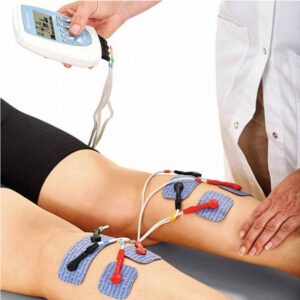
TENS electrode placement around the knee
For knee pain, TENS electrodes are generally positioned around the painful region rather than directly on the kneecap.
Four-electrode placement
Electrodes can be arranged:
- above the knee on the medial side;
- above the knee on the lateral side;
- below the knee on the medial side;
- below the knee on the lateral side.
This creates a stimulation field around the knee joint. Do not place electrodes directly over the patella, an unhealed surgical wound, a dressing or significantly damaged or irritated skin.
Two-electrode placement
If the painful area is more localised, one electrode can be positioned slightly above the symptomatic region and the second below it. For example, with localised medial knee pain, both electrodes can remain on the medial side of the knee.
Do not confuse a TENS arrangement around the knee with an EMS/NMES arrangement for the quadriceps. TENS is primarily intended to influence pain perception, while quadriceps NMES electrodes are positioned over the thigh muscles to produce a muscular contraction.

Quadriceps EMS electrode placement
Electrical stimulation of the quadriceps is commonly used in rehabilitation when muscle activation is impaired, including in selected patients following knee surgery, and it may also be used as an adjunct to strength training.
Simple two-electrode arrangement
- a larger electrode over the upper or middle portion of the front of the thigh;
- a second electrode over the lower portion of the quadriceps above the knee.
Broader three-electrode arrangement
Some device-specific configurations use:
- one larger electrode positioned higher over the quadriceps;
- one smaller electrode over the vastus medialis region above the medial side of the knee;
- a second smaller electrode over the vastus lateralis region above the lateral side of the knee.
Compex quadriceps placement diagrams use a larger proximal electrode and smaller distal electrodes over the vastus medialis and vastus lateralis regions. The exact cable or connector configuration depends on the particular Compex model and electrode type.
With effective placement:
- the contraction should involve a substantial portion of the quadriceps;
- the patella may move slightly upwards as the quadriceps contracts;
- the stimulation should not feel sharply painful or burning;
- the response should not consist only of a small local twitch underneath one electrode.
After surgery, NMES should be used according to the instructions of the surgeon or physiotherapist. Electrodes should never be placed directly over an unhealed surgical wound.

TENS electrode placement for the elbow and forearm
Elbow pain is often associated with loading of the forearm muscles and tendons. TENS electrodes are generally more comfortable when positioned on the soft tissues around the painful region rather than directly on a prominent bony part of the elbow.
For pain on the outside of the elbow
One electrode can be positioned over the upper part of the extensor muscle group on the outer side of the forearm, with the second several centimetres lower along the wrist and finger extensor muscles.
For pain on the inside of the elbow
The electrodes can be positioned over the flexor muscles on the inner side of the forearm. One electrode may be placed closer to the elbow and the second lower down over the muscle belly.
When EMS is used, the electrode pair should follow the muscle group that is being stimulated. Compex forearm placement diagrams position small electrodes over the upper and lower portions of the relevant wrist and finger flexor or extensor muscle group.

EMS electrode placement for the hamstrings
For hamstring stimulation, the electrodes are positioned over the muscle belly on the back of the thigh:
- one electrode higher on the posterior thigh below the gluteal fold, but not directly on the fold itself;
- the second lower down over the middle portion of the posterior thigh;
- when two channels are used, the electrode pairs may be distributed according to the medial and lateral hamstring muscle regions, depending on the device and programme.
Do not place electrodes directly in the popliteal fossa behind the knee or directly over the ischial tuberosity. The contraction should involve the posterior thigh smoothly without producing a sharp or burning sensation.
EMS electrode placement for the calf muscles
In a simple arrangement, one electrode is positioned over the upper part of the calf muscle and the second lower down over the same muscle belly.
If the medial and lateral heads of the gastrocnemius are being stimulated separately with an appropriate multi-channel programme, two channels may be used:
- one electrode pair over the medial portion of the calf;
- the second pair over the lateral portion.
Do not position the electrodes directly over the Achilles tendon or in the hollow behind the knee. Compex calf-placement guidance uses a larger electrode over the upper calf and smaller electrodes lower over the muscle belly.

How do you know if the electrodes are positioned correctly?
With TENS
Appropriate positioning is generally characterised by:
- an even tingling sensation;
- stimulation that covers or surrounds the symptomatic area;
- no burning or sharp stinging sensation;
- no unpleasant involuntary muscle twitching;
- the ability to increase the intensity to a strong but comfortable level.
With EMS or NMES
Appropriate positioning is generally characterised by:
- a visible contraction of the target muscle;
- a relatively even muscular contraction;
- the contraction can be produced without requiring an unnecessarily high current;
- adjacent muscles do not dominate the contraction instead of the intended target muscle;
- any resulting joint movement remains controlled and safe.
If the muscle contraction is weak or occurs only immediately underneath one electrode, switch the stimulation off, move the electrode slightly and then reassess the muscular response.
When precise motor-point localisation is required, a stimulation pen can be more accurate than relying solely on a general anatomical diagram.
What size electrodes should you choose?
| Body area | Commonly suitable size | Note |
|---|---|---|
| Forearm and small local areas | Smaller round electrodes or approximately 5 × 5 cm | Allows more precise positioning |
| Shoulder and upper arm | 5 × 5 cm or a combination with a larger electrode | Depends on the size of the target muscle |
| Around the knee for TENS | 5 × 5 cm | Convenient for positioning around the joint |
| Quadriceps and hamstrings | 5 × 9 cm or 5 × 10 cm, sometimes combined with smaller electrodes | Useful for stimulating a larger muscle area |
| Calf muscles | 5 × 5 cm or 5 × 9 cm | Choice depends on calf size and the device setup |
| Lower back | 5 × 5 cm or 5 × 9 cm | Larger electrodes may provide a more distributed sensation |
The Fiziopreces.lv range includes 5 × 5 cm, 5 × 9 cm and 5 × 10 cm self-adhesive electrodes for different TENS and EMS devices. Before purchasing, always check the connector type and compatibility with your specific electrostimulation device.
Common mistakes when placing TENS and EMS electrodes
Placing electrodes directly over bone or a tendon
Stimulation over a prominent bony area or tendon can feel sharper and may produce a poor muscular contraction. For EMS, electrodes should generally be positioned over the muscle belly. For TENS, they are usually positioned on healthy soft tissue around or close to the painful region.
Using a TENS placement for muscle strengthening
Positioning electrodes around the knee can be appropriate for a TENS pain programme, but it will not activate the quadriceps in the same way as an NMES arrangement in which the electrodes are positioned over the anterior thigh muscles.
Using an intensity that is too low
With TENS, a barely perceptible tingling sensation may not provide the intended effect when the programme is designed to deliver strong but comfortable sensory stimulation. With EMS/NMES used for muscle activation or strengthening, a slight twitch is not equivalent to a strong, controlled muscular contraction.
Using dried-out or partially detached electrodes
Poor electrode contact can result in uneven current distribution, a sharp sensation and skin irritation. Worn, damaged or poorly adhering electrodes should be replaced.
Moving electrodes while the device is running
Before moving an electrode, reduce the stimulation intensity to zero or switch the device off.
Stimulating an area with significantly reduced sensation
If a person cannot adequately feel the stimulation intensity, there is a greater risk of using excessive current or causing skin irritation. Avoid unsupervised stimulation over areas with markedly reduced sensation and follow the specific device instructions.
Where should TENS and EMS electrodes not be placed?
For standard consumer TENS and EMS devices, electrodes should generally not be positioned:
- on the head, face or close to the eyes unless a specific medical device and protocol is explicitly designed for such use;
- over the front or side of the neck or throat;
- in a configuration that sends electrical current across the chest;
- with one electrode on the chest and another on the back so that the current crosses the torso;
- over an open wound, infected skin or significantly inflamed skin;
- over an area with markedly reduced or absent sensation unless specifically supervised and indicated;
- directly over a fresh or unhealed surgical wound;
- inside the mouth or over the genital area;
- using another person’s self-adhesive electrodes.
Device-specific safety instructions take priority. Compex safety guidance, for example, warns against placing electrodes on the head or throat and against configurations in which the electrical current crosses the torso.
Do not begin electrostimulation without appropriate medical guidance if you have a cardiac pacemaker, implanted defibrillator or another implanted electronic medical device. Additional caution and device-specific advice are necessary during pregnancy, with epilepsy, significant cardiac disease or symptoms of unclear origin. Always check the contraindications listed in the instructions for your particular device.
Frequently asked questions about TENS and EMS electrode placement
How do I know which two electrodes belong to the same stimulation channel?
Each conventional lead or stimulation channel generally connects one electrode pair. Both electrodes from the same channel should be positioned within one logical stimulation area, for example on either side of a painful region or over different portions of the same target muscle.
If your device has several channels, check the cable markings and the electrode-placement instructions for that specific model before beginning treatment.
Do electrodes need to be perfectly symmetrical on both sides of the body?
Not necessarily. TENS placement should be adapted to the location of the symptoms, while EMS placement depends on the shape of the target muscle and the location of its motor points.
Symmetrical placement can be practical when stimulating both legs, but the optimal motor-point position may differ slightly between the right and left sides.
What should I do if I feel a sharp stinging sensation under one electrode?
First switch the device off and check whether the entire electrode surface is making good contact with the skin. A sharp sensation may occur when an edge of the electrode has lifted, the conductive layer has dried out or the skin underneath the electrode is irritated.
If the sensation remains after replacing or repositioning the electrode, stop the procedure.
Can I move the electrodes while the device is switched on?
No. Before repositioning, attaching or removing electrodes, switch the device off or reduce the intensity of all active channels to zero. After checking the new position, gradually increase the intensity again.
Can electrodes be placed over thick body hair?
Thick body hair can prevent an electrode from adhering evenly and can reduce contact with the skin. If necessary, carefully trim excessive hair rather than shaving immediately before treatment, as shaving can irritate the skin.
How can I find the best EMS motor-point location?
Start with the manufacturer’s recommended electrode-placement diagram and gradually increase the stimulation intensity.
If the muscular response is weak, switch the device off and move the smaller electrode a short distance before testing again. At a more responsive motor-point position, the same stimulation intensity will generally produce a stronger contraction of the target muscle.
Can both legs or both arms be stimulated at the same time?
This may be possible if the device has enough independent channels and the selected programme is designed for that application. Each channel should stimulate a clearly defined muscle group, and the person should be positioned securely so that the contraction cannot cause loss of balance or uncontrolled joint movement.
Always follow the specific instructions for your device and programme.
Do the electrodes need to be placed in exactly the same position every session?
With EMS, using a similar placement helps stimulate the same muscle and motor-point region consistently.
If TENS is used repeatedly, the electrodes can sometimes be moved slightly within the appropriate treatment area to avoid repeatedly loading exactly the same area of skin. If redness, itching or tenderness develops underneath the electrodes, stop treatment until the skin has recovered.
Do self-adhesive electrodes require additional electrode gel?
Usually not. Self-adhesive electrodes normally already contain a conductive gel layer. Additional conductive gel should only be used if the manufacturer of the electrode and stimulation device specifically permits it.
Summary
The aim of TENS electrode placement is to cover or surround the painful region while producing strong but comfortable sensory stimulation. EMS and NMES electrode placement is intended to activate a specific muscle, which is why motor-point location and placement over the muscle belly are important.
The most important principles are:
- use the correct electrode pair for each stimulation channel;
- apply electrodes only to clean, healthy skin;
- do not allow electrodes to overlap;
- with TENS, cover or surround the symptomatic region;
- with EMS/NMES, stimulate the muscle belly and appropriate motor-point regions;
- select an electrode size appropriate for the body area and device;
- replace dried-out, damaged or poorly adhering electrodes;
- do not create a current path across the chest;
- always follow the instructions and contraindications for your specific device.
References
Johnson MI, Paley CA, Jones G, Mulvey MR, Wittkopf PG. Efficacy and safety of transcutaneous electrical nerve stimulation for acute and chronic pain in adults: the meta-TENS study. BMJ Open. 2022;12:e051073.
Gobbo M, Maffiuletti NA, Orizio C, Minetto MA. Muscle motor point identification is essential for optimizing neuromuscular electrical stimulation use. Journal of NeuroEngineering and Rehabilitation. 2014;11:17.
Gobbo M, Gaffurini P, Bissolotti L, Esposito F, Orizio C. Transcutaneous neuromuscular electrical stimulation: influence of electrode positioning and stimulus amplitude settings on muscle response. European Journal of Applied Physiology. 2011;111(10):2451–2459.
Botter A, Oprandi G, Lanfranco F, et al. Atlas of the muscle motor points for the lower limb: implications for electrical stimulation procedures and electrode positioning. European Journal of Applied Physiology. 2011;111(10):2461–2471.
Nussbaum EL, Houghton P, Anthony J, et al. Neuromuscular Electrical Stimulation for Treatment of Muscle Impairment: Critical Review and Recommendations for Clinical Practice. Physiotherapy Canada. 2017;69(5):1–76.
Compex. Electrode Placement Guide and Safety Guidance.
Related Articles
📖 TENS Therapy for Pain Relief – How to Use It Safely and Effectively
📖 Compex Electrostimulation Devices – FIT and SP Models Compared
📖 NeuroTrac Electrostimulators – TENS, REHAB, MultiTENS, SPORTS XL and Continence Compared
📖 Chattanooga Rehab, Theta and Physio – Professional Electrostimulators Compared
Is It Enough to Copy Electrode Placement from an Image Found Online?

Aigars Caune
Physiotherapist
An anatomical image is a useful starting point, but especially with EMS, motor-point location can vary between individuals. If the contraction is weak, uncomfortable or activates the wrong muscle, the electrode position should be adjusted. The most useful position is the one that produces a strong and even contraction of the intended muscle at a tolerable stimulation intensity.
Recommended Products

Electrical stimulation

Electrical stimulation
Electrical stimulation
Electrical stimulation
Looking for More Practical Physiotherapist Advice?
Visit our Physiotherapist Recommendations section for practical articles about exercise, injury prevention, pain management, load modification, rehabilitation principles and safely returning to everyday activities or sport.
View Physiotherapist Recommendations