






Rehabilitation
Tennis Elbow (Lateral Epicondylitis): Symptoms, Treatment and When a Brace Helps

Dec
Pain on the outside of the elbow often begins gradually – when lifting a shopping bag, using a computer mouse or screwdriver, or after a period of more intensive training. This is why tennis elbow (lateral epicondylitis) is relevant not only to athletes, but also to office workers, tradespeople and anyone who repeatedly performs similar hand and forearm movements.
Despite its name, most people with tennis elbow do not actually play tennis. Tennis elbow, also known as lateral epicondylitis or lateral elbow tendinopathy, is an overload-related condition affecting the tendons on the outside of the elbow. The wrist extensor muscles, particularly the tendon complex attaching around the lateral epicondyle, are most commonly involved.
When these tissues are repeatedly loaded beyond their current capacity to recover and adapt, pain and tendon-related changes can gradually develop. For this reason, persistent tennis elbow is better considered a tendinopathy rather than simply an inflammatory condition.
What is tennis elbow and why does it develop?
In practice, tennis elbow is usually not caused by one specific traumatic event. More often, the problem develops gradually when the load placed on the tendon becomes greater than the tissue can currently tolerate.
This can happen after a busy season of gardening, home renovation, frequent use of a computer mouse, repeated work with tools, lifting or sporting activities involving repeated gripping and wrist movements.
It is important to understand that symptoms are not caused only by the number of repetitions. Technique, insufficient recovery, muscle weakness and how quickly the workload has been increased may also contribute.
Two people can perform the same activity, yet only one develops symptoms. This is one reason why treatment rarely consists of a single solution.
Tennis elbow symptoms you should not ignore
The most characteristic symptom is pain on the outside of the elbow. Initially, pain may occur only during physical activity, but later it can interfere with normal everyday tasks.
For example, symptoms may appear when opening a door, lifting a cup, shaking someone’s hand, carrying a bag or gripping an object.
Many people also notice that the affected arm feels weaker. Grip strength may decrease, and discomfort can spread from the outside of the elbow into the forearm.
The pain may sometimes feel sharp, while at other times it may be a dull, pulling or fatiguing sensation. If the condition becomes persistent, sensitivity can occasionally remain even when the arm is relatively rested.
Typical symptoms include:
- pain on the outside of the elbow;
- discomfort when extending the wrist or fingers against resistance;
- pain when lifting objects with the arm extended;
- reduced or painful grip strength;
- tenderness when pressing around the outside of the elbow.
If the pain is mainly on the inside of the elbow, another condition such as golfer’s elbow should also be considered. If you have tingling or numbness in the fingers, significant swelling or locking of the joint, the symptoms may not represent typical tennis elbow.
How do you know whether it is really tennis elbow?
In uncomplicated cases, an experienced healthcare professional can often identify lateral elbow tendinopathy from the history, the exact location of pain and several simple functional tests.
The assessment usually considers where the pain is located, which movements reproduce it, how gripping affects symptoms and whether there is a meaningful loss of strength or function.
Imaging is not necessary for everyone. If the symptoms are typical and there is no suspicion of another injury, a clinical assessment is often sufficient initially.
However, if the pain persists despite appropriate management, followed a significant traumatic injury or does not fit the usual pattern of tennis elbow, a doctor may recommend additional investigations.
Tennis elbow treatment – what actually helps?
The encouraging part is that most people with tennis elbow can be managed conservatively. The less convenient part is that recovery is rarely immediate. If tendon symptoms have developed over several months, improvement will usually also occur gradually.
The first step is to reduce or modify the activity that is repeatedly aggravating the tendon. This does not usually mean completely avoiding use of the arm.
Instead, identify the activities that create the largest increase in symptoms and temporarily modify them. This may involve changing the grip, using a different tool, reducing training volume, altering technique or taking more frequent breaks.
The next important component is exercise. Progressive strengthening can help restore the tendon’s ability to tolerate gripping, wrist extension and repeated forearm loading.
Exercise programmes commonly include progressive loading for the wrist extensors and forearm muscles. Depending on the individual, rehabilitation may also include grip exercises and shoulder-girdle strengthening because elbow loading occurs as part of the entire upper-limb movement chain.
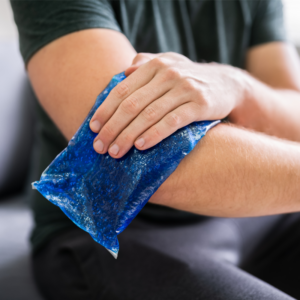
During a more painful period, cold can be used after activity if it provides temporary symptom relief. Medication or anti-inflammatory treatment should be considered individually and discussed with a doctor or pharmacist when appropriate. These approaches may help symptoms, but they do not replace appropriate load management and progressive rehabilitation.
Physiotherapy can be especially useful when it is unclear which exercises are suitable, how much resistance should be used or how quickly the programme should progress. An overly aggressive approach may aggravate symptoms, whereas consistently avoiding meaningful loading may leave the tendon poorly prepared for returning to normal activities.
How should exercises for tennis elbow be dosed?
In tennis elbow or lateral elbow tendinopathy, symptoms are commonly associated with overload of the wrist extensor muscles and their tendons on the outside of the forearm. The purpose of rehabilitation is therefore not simply to increase muscle strength, but to progressively improve the tendon’s ability to tolerate repeated gripping, wrist extension and forearm loading.
One practical way to dose exercises is by working time rather than relying only on repetitions or the amount of weight used.
For example, an exercise may initially be performed for 25 seconds, followed by a gradual progression to 30, 35, 40, 45 and eventually 50 seconds.
This provides a simple way to control the duration of tendon loading and progressively increase the total amount of work.
Each exercise can be performed for several sets. A practical starting point may be 2–3 sets. As the tendon becomes more tolerant and symptoms improve, the programme can gradually progress towards 4–5 sets.
Progression can also be created by increasing resistance, slowing the movement tempo, changing the grip position or progressing to more demanding exercises.
The important principle is to increase the load gradually. A mild and manageable level of discomfort may sometimes occur during tendon rehabilitation, but the exercise should not cause a major increase in pain during the session or a clear worsening of symptoms the following day.
Practical exercises for epicondylitis
Reducing pain is only one part of treating epicondylitis. Progressive restoration of tendon load tolerance is equally important. We have therefore prepared a separate article with practical physiotherapy exercises that can be used for both tennis elbow and golfer’s elbow.
When can a tennis elbow brace help?
A brace or counterforce strap is not a cure for tennis elbow, but it can provide useful short-term support for some people.
The aim of a counterforce strap is to alter how load is transmitted through the forearm muscle-tendon complex. For some people, this can reduce pain during gripping or other provoking activities and make everyday tasks more comfortable.
A brace may be particularly useful when symptoms occur during repeated gripping, working with tools, gardening, lifting or sporting activities.
It can also be useful during a transitional period when a person is continuing rehabilitation exercises but cannot completely avoid work or sport-related demands.
There is one important limitation: a brace may reduce symptoms, but it does not restore tendon capacity on its own. If it is used as the only treatment while the same aggravating workload continues unchanged, the benefit may be temporary.
For this reason, a tennis elbow strap generally works best as an additional tool alongside load modification, progressive exercise and, when necessary, professional assessment.
How to choose a brace for tennis elbow
Two commonly used options are a counterforce epicondylitis strap placed around the upper forearm and a more extensive compression elbow brace.
The most suitable choice depends on the symptoms and the activities during which support is required.
A counterforce strap is generally compact and convenient for work or sport. It applies targeted pressure around the forearm muscle area and may be suitable when specific gripping or wrist-loading activities provoke symptoms.
An elastic compression elbow brace covers a larger area and may provide a broader feeling of compression, warmth and support. Some people find this more comfortable for everyday use.
Correct size and positioning are important. A brace that is excessively tight can create additional discomfort, while one that is too loose may provide little useful effect.
If the hand becomes numb, starts tingling, becomes cold or you feel excessive pressure after applying the brace, loosen or remove it and reassess the fit.
There is no single brace that is best for everyone. The orthoses and epicondylitis straps available from Fiziopreces.lv are intended to provide functional support during daily activities and rehabilitation, and the most appropriate option depends on the individual’s symptoms and intended use.
When is a brace not enough?
If pain remains for several weeks without improvement, progressively worsens or begins to cause significant symptoms even at rest, it is not advisable to rely only on self-management or a brace.
Professional assessment is also appropriate if there is marked loss of strength, significant night pain, tingling or numbness in the hand, substantial swelling or suspicion of another injury.
Similar symptoms can sometimes arise from problems involving the cervical spine, peripheral nerves or other structures around the elbow. Accurate assessment becomes particularly important when the expected treatment approach is not helping.
What can you do in everyday life to reduce recurrence?
Once the more irritable phase settles, the goal is not simply to make the elbow feel better temporarily but to reduce the likelihood of symptoms returning.
This means continuing appropriate exercise while also reviewing the daily activities that repeatedly load the tendon.
Workstation ergonomics, grip position, breaks between repetitive tasks and gradual progression back into sporting activity can all be relevant.
If you work at a computer, consider how you use the mouse, whether the forearm is adequately supported and your wrist and hand position.
If the problem is associated with manual work, changing technique, tool choice or distributing the workload between both arms may help.
In sport, it can be useful to look beyond the elbow alone. Shoulder strength and control, grip capacity, training volume, technique and equipment can all influence how much load reaches the forearm and elbow.
Tennis elbow can be frustrating, but in most cases it can be managed successfully with an appropriate conservative approach. Responding early to symptoms, modifying excessive load and progressively rebuilding capacity can reduce the risk of a prolonged interruption from work, sport or other normal activities.
Related Articles
📖 Rehabilitation Equipment for Home: What Should You Choose?
📖 5 Exercises to Relieve Carpal Tunnel Symptoms
📖 TENS Therapy for Pain Relief
Why Does Tennis Elbow Pain Often Return Just When It Seems to Have Gone Away?

Aigars Caune
Physiotherapist
When pain decreases, it is tempting to immediately return to the previous workload. This is a common stage for symptoms to return. The tendon may feel better before it has actually regained enough capacity to tolerate the full previous workload.
Recommended Products


For gymnastics


Orthosis and compression clothing


For gymnastics


Exercise bands and espanders
More Articles About Rehabilitation
Looking for more information about rehabilitation? Visit our rehabilitation section, where you will find articles about recovery after injuries and surgery, rehabilitation exercises, physiotherapist recommendations and safely returning to everyday activities and sport.
View Rehabilitation Articles