







Physiotherapist's recommendations, Uncategorized
Sports First Aid Kit: What Should It Contain?

Dec
The contents of a sports team’s medical bag should first be adapted to the risks of the specific sport. In football, common situations include abrasions, bleeding wounds, ankle sprains, collisions and finger injuries. In cycling, greater attention may be needed for larger abrasions, blisters and injuries caused by falls. In basketball, volleyball and handball, materials for supporting the fingers, wrists and ankles are often particularly useful.
The number of people also matters. A first aid kit for a team of ten athletes can be considerably smaller than a medical bag intended for a multi-team tournament or sports camp. The greater the number of participants and the longer the event, the more gloves, gauze, bandages, plasters and other disposable materials will be required.
The location of the competition should also be considered. If a match takes place in a sports complex with medical personnel, an automated external defibrillator and easy access for emergency medical services, the role of the team medical bag will differ from that during an away training session, hike or tournament abroad. Before an event, it is useful to know the exact address, the best access point for emergency vehicles and the location of the nearest automated external defibrillator (AED).
Materials for wound care and bleeding
Abrasions, cuts, split eyebrows, nosebleeds and minor skin injuries are common in sport. A sports medicine bag should therefore contain an adequate supply of disposable gloves, sterile gauze pads, bandages, plasters and medical adhesive tape.
Gloves should be worn before providing first aid. A bleeding wound will usually require direct pressure with sterile gauze or a dressing. If the first layer becomes soaked with blood, it should generally be left in place, with additional material placed over it while direct pressure is continued. For life-threatening external bleeding, direct pressure is one of the key initial first aid measures.
It is also practical to keep sterile saline or a suitable wound irrigation solution in the sports medical bag. This is particularly useful for abrasions containing sand, grass or other debris. After the wound has been cleaned, it can be covered with an appropriately sized sterile dressing.
Large, deep or heavily bleeding wounds should not be fully treated at the competition venue. The immediate priorities are to control the bleeding, protect the wound and arrange appropriate professional medical care.
Cold packs and cold spray
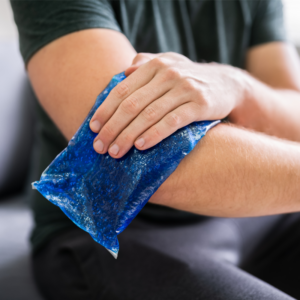
Cold therapy products are among the most commonly used items in a sports team’s medical bag. A reusable cold gel pack is a practical choice when a freezer or cooler is available at the venue. For away matches and travel, instant disposable cold packs that are activated by squeezing the package can be useful.
The main advantage of cold spray is speed and convenience. It does not require freezing, takes up little space and can provide a temporary cooling and pain-relieving sensation. However, its effect is superficial and short-lived. Cold spray does not replace proper injury assessment and spraying an injured area does not automatically mean that an athlete is safe to continue playing.
Cold spray should not be applied to open wounds, abrasions or near the eyes or mucous membranes. It should be used from the distance specified by the manufacturer, avoiding prolonged spraying over one area because excessive cooling can damage the skin.

Sports tape, elastic bandages and underwrap
Sports tape is a useful addition to a medical bag, particularly in football, basketball, volleyball, handball and other sports in which ankle, wrist and finger injuries are common.
Rigid sports tape can be used to provide additional mechanical support to a joint or to secure a dressing. Underwrap can be placed underneath rigid tape to reduce friction and improve comfort. Cohesive or self-adherent bandage is useful for securing plasters, gauze and other materials because it adheres to itself rather than directly to the skin.
An elastic bandage can be used to provide light compression or secure a dressing. It should never be wrapped so tightly that tingling, numbness, changes in skin colour or a cold sensation develops in the fingers or toes.
Sports taping requires appropriate knowledge and practical skills. Incorrectly applied tape can restrict circulation, irritate the skin or create a false sense of security. Tape should not be used to hide a significant injury simply to allow an athlete to continue playing without an appropriate assessment.
When preparing a first aid kit for a team or individual sporting activity, consider the tape’s elasticity, width, adhesive characteristics and intended purpose. Read more in our guide Buying Sports Tape Online – What to Check Before Ordering.


Emergency foil blanket for reducing heat loss
An emergency foil blanket takes up very little space, but in certain situations it can be one of the most valuable items in a first aid kit. It helps reduce body heat loss while an injured person is waiting for medical assistance.
An emergency blanket is particularly useful during outdoor sports in cool or rainy weather. If an athlete is unable to continue moving after an injury and remains lying on a cold or wet surface, body temperature can fall relatively quickly. The risk increases if clothing is wet, the athlete is exhausted or there is a prolonged wait for assistance.
Where possible, first protect the injured person from the cold ground and moisture and then cover them with the emergency blanket. The face and airway should remain uncovered. An emergency blanket does not replace calling emergency medical services, but it can help reduce heat loss while waiting for assistance.


Should warming massage cream be kept in a sports medical bag?
Warming massage cream can be carried in a sports team’s medical bag, but it should not be considered an essential first aid item. These products can create a subjective sensation of warmth and may feel pleasant before exercise or during massage, but they do not replace an active warm-up.
Before training, muscles and joints should be prepared through progressively increasing movement intensity, sport-specific exercises and movements that reflect the demands of the upcoming activity. Warming cream by itself does not prepare muscles for sprinting, jumping or changing direction and does not guarantee protection against injury.
Warming products should not be applied to a fresh injury, swollen area, abrasion or other damaged skin. They should be used according to the manufacturer’s instructions, with hands washed after application and contact with the eyes avoided.
Practical additions to a sports team’s medical bag
In addition to the contents of a standard first aid kit, several additional items can be useful for a sports team. Hydrocolloid blister plasters and ordinary plasters in several sizes can be included for blister care. Additional sterile gauze pads, saline solution and cohesive bandages are useful for wound management.
Additional elastic bandages, rigid sports tape and a triangular bandage may be useful for ankle, wrist or finger injuries. Several pairs of disposable gloves should be available because gloves may need to be changed more than once during a single incident.
Other practical items include a small waste bag for used or blood-contaminated materials, hand sanitiser, a pen, an incident-recording sheet and emergency contact information for the players.
The person responsible for the team should know where the nearest automated external defibrillator is located and how to summon emergency assistance at the specific venue. A well-organised emergency action plan can be just as important as the contents of the medical bag itself.
Should medications be kept in the medical bag?
Medications are not an obligatory part of a standard first aid kit. Within a sports team, medications should not be stored and administered without a clear procedure, an appropriately responsible person and information about the athlete’s medical conditions, allergies and possible contraindications.
Particular caution is required with prescription medicines, injections, strong pain medication and other specific pharmaceutical products. Their use should be supervised by a doctor or another appropriately qualified healthcare professional.
In competitive sport, the anti-doping status of medication should also be checked before use. The WADA 2026 Prohibited List has been in force since 1 January 2026. Athletes and support personnel in Latvia can also use the Latvian Anti-Doping Bureau’s medication-checking system to verify medicines available in Latvia.
How should a sports medical bag be organised?
The contents of a medical bag should not only be available but also organised logically. In an emergency, several minutes should not be spent searching for gloves, gauze or a resuscitation mask.
A practical approach is to separate equipment into clearly labelled compartments. One compartment can contain gloves and a resuscitation mask, another wound-care materials, and another sports tape and elastic bandages. Cold therapy products, the emergency blanket and additional equipment can have their own section of the bag.
The most important items should be accessible without completely emptying the bag. Frequently used materials such as gloves, sterile gauze, plasters and scissors are best kept in an external or upper compartment.
How often should a first aid kit be checked?
A sports medical bag should be checked before the season, before away trips and regularly throughout the year. After every use, consumed materials should be replaced immediately rather than waiting until the next match.
Expiry dates on dressings, sterile gauze, plasters, instant cold packs and other products should be checked regularly. Packaging should also be inspected. A sterile product with damaged, open or wet packaging should no longer be considered reliably sterile.
Aerosols and other temperature-sensitive products should be stored according to the manufacturer’s instructions. A medical bag should not be left for prolonged periods in a hot vehicle, damp environment or somewhere that cannot be accessed quickly.
Ideally, one specific person should be responsible for checking and restocking the medical bag. A simple inventory list can also be kept inside the bag showing the required quantities and expiry dates of key products.
Common mistakes when preparing a first aid kit
One common mistake is assuming that buying a ready-made first aid kit once is enough and that it never needs to be checked again. Supplies are gradually used, packaging can become damaged and products can expire.
Another mistake is carrying a very large number of different products without a clear understanding of how they are used. A bag may be large and heavy but still lack enough gloves, gauze or an appropriate dressing when it is genuinely needed.
It is also important not to rely primarily on cold sprays, warming creams and sports tape. These are supplementary products rather than the foundation of first aid. Priorities include rescuer safety, assessing the injured person’s condition, controlling life-threatening bleeding, activating emergency medical services when necessary and continuing to monitor the person’s condition.
Summary
The foundation of a first aid kit should include disposable gloves, a resuscitation mask or face shield, sterile dressings, gauze, plasters, medical adhesive tape, scissors, triangular bandages and an emergency foil blanket.
A sports team’s medical bag should then be expanded according to the risks of the specific sport. Useful additions include cold packs, cold spray, sports tape, elastic and cohesive bandages, wound irrigation products and blister-care materials.
Warming cream, sports tape and cold spray can be useful additions, but they do not replace an active warm-up, injury assessment or professional medical care. The first aid bag should be checked regularly, restocked after every use and stored somewhere that is easily accessible.
The information in this article is educational and does not replace first aid training or individual advice from a qualified healthcare professional.
Related Articles
📖 Sports Tape for Joint Support, Injuries and Prevention
📖 How to Treat an Ankle Sprain?
📖 Why Is Early Loading Important After Soft-Tissue Injuries?
Is a Standard Car First Aid Kit Enough for a Sports Team?

Aigars Caune
Physiotherapist
A standard first aid kit is a useful starting point because it usually contains gloves, bandages, plasters, gauze, a resuscitation mask and an emergency blanket. However, this is usually not enough for a sports team. Sport commonly requires additional cold packs, sports tape, elastic and cohesive bandages, wound irrigation solution, blister plasters and a larger quantity of disposable materials. The contents of the medical bag should be adapted to the sport, the number of athletes and how quickly professional medical assistance can be accessed at the venue. The most important consideration is not how many products are inside the bag, but whether the necessary equipment can be found quickly and the responsible person knows how to use it correctly.
Recommended Products


Cold/heat packs


Cold sprays

First aid
Looking for More Practical Physiotherapist Advice?
Visit our Physiotherapist Recommendations section for practical articles about exercise, injury prevention, pain management, load modification, rehabilitation principles and safely returning to everyday activities or sport.
View Physiotherapist Recommendations