






Physiotherapist's recommendations, Uncategorized
Osgood-Schlatter Disease in Children and Adolescents: Symptoms, Treatment and Exercises

Apr
Sport and regular physical activity are important for a child’s health and development. However, during periods of rapid growth, especially in children and adolescents who regularly run, jump or train several times per week, pain can develop at the front of the knee.
One of the common causes of this type of pain is Osgood-Schlatter disease. It typically causes pain and tenderness below the knee joint, where the patellar tendon attaches to the tibial tuberosity.
Although the term “disease” is used in its name, Osgood-Schlatter disease is generally not a dangerous or irreversible injury to the knee joint. It is a growth- and load-related condition that is most often managed without surgery by modifying sports load and gradually improving leg strength and tolerance to physical activity.
What is Osgood-Schlatter disease?
Osgood-Schlatter disease is a traction apophysitis of the tibial tuberosity. The tibial tuberosity, or tuberositas tibiae, is the bony prominence below the knee where the quadriceps muscle attaches indirectly through the patellar tendon.
In children and adolescents, this area has not yet fully matured. During periods of rapid growth, repeated running, jumping, rapid changes of direction and forceful knee extension create traction forces where the patellar tendon attaches to the growing bone.
If the amount of loading exceeds the tissue’s current ability to recover, pain, swelling and tenderness can develop. Over time, the bony prominence below the knee may become more noticeable.

The condition is particularly common in sports involving frequent running and jumping, including football, basketball, volleyball, athletics and gymnastics.
Who is most likely to develop Osgood-Schlatter disease?
Osgood-Schlatter disease usually develops in children and adolescents during periods of rapid growth. Symptoms often begin slightly earlier in girls and somewhat later in boys because the timing of puberty and growth differs.
Risk may be greater in young people who:
- train several times per week;
- participate in several teams or sports at the same time;
- rapidly increase training or competition load;
- regularly run, jump and change direction;
- return too quickly to full training volume after a break;
- experience reduced flexibility of the thigh or lower-leg muscles during growth;
- have not developed sufficient strength in the leg and hip muscles.
Osgood-Schlatter disease can affect one or both knees.
Common symptoms
Pain is most commonly felt directly below the knee joint over the tibial tuberosity.
Typical symptoms include:
- pain when running, jumping or rapidly changing direction;
- pain during squats or lunges;
- discomfort when kicking a ball;
- tenderness when touching the area below the knee;
- pain when kneeling;
- local swelling;
- a more prominent bony bump below the knee;
- pain after training or the following morning;
- temporary limping after heavier physical activity.
Pain usually increases during physical activity and decreases with rest. However, when symptoms are more pronounced, discomfort may also be present during everyday activities.
How is Osgood-Schlatter disease diagnosed?
Osgood-Schlatter disease is most commonly diagnosed based on the child’s symptoms and a clinical examination.
A doctor or physiotherapist may assess:
- the precise location of pain;
- tenderness and swelling;
- pain during knee extension;
- squat, jumping and walking mechanics;
- strength of the thigh, hip and calf muscles;
- lower-limb mobility;
- training frequency and recent changes in physical load.
An X-ray is not always necessary. Imaging may be considered when symptoms are atypical, pain is particularly severe, there has been a significant injury or another cause of knee pain needs to be excluded.
Does a child need to stop sport completely?
Complete cessation of sport is not automatically necessary for every child. Training load should be modified according to the intensity of symptoms and how the knee responds during and after activity.
If a child can participate with mild symptoms, pain does not progressively increase during the session and symptoms are not noticeably worse the following day, continuing some activities may be acceptable.
Training load should be reduced if:
- pain progressively increases during training;
- the child begins to limp;
- running or jumping mechanics change;
- pain remains noticeably worse the following day;
- the knee also hurts during everyday activities;
- the child can no longer perform exercises normally.
It is often unnecessary to stop all physical activity. Sprinting, jumping, deep squats and repeated kicking can temporarily be reduced while maintaining less provocative strength exercises, cycling, swimming or other well-tolerated activities.
Load management is one of the most important parts of treatment. A promising approach includes education, activity modification, progressive knee strengthening and a controlled return to sport.
How is Osgood-Schlatter disease treated?
Treatment is usually conservative, and surgery is required only rarely. The main goals are to reduce excessive irritation, maintain physical capacity and gradually improve the knee’s ability to tolerate load.
1. Modify training load
It is important to consider not only the intensity of one training session but the total weekly load, including:
- team training;
- individual training;
- school sport;
- competitions;
- strength training;
- active recreational activities.
Sometimes the problem is not caused by one particular exercise but by the accumulated effect of several different forms of loading without sufficient recovery.
2. Progressively develop strength
Completely unloading the leg for a prolonged period can reduce muscle strength and make the eventual return to sport more difficult. Progressive strengthening is therefore an important part of treatment.
Depending on the symptoms, exercises may include:
- static quadriceps contractions;
- straight-leg raises;
- hip and gluteal strengthening exercises;
- bridges;
- controlled shallow squats;
- step-ups onto a low platform;
- progressive lunges;
- calf strengthening;
- balance exercises;
- later, progressive running, jumping and landing exercises.
Exercise difficulty should be increased gradually while monitoring symptoms during the session and on the following day.
3. Improve mobility where necessary
During rapid growth, some children experience reduced flexibility around the front and back of the thigh. Gentle mobility exercises can be useful, but stretching should not provoke sharp pain around the tibial tuberosity.
There is no need to aggressively stretch a painful leg or attempt to forcefully “release” the quadriceps muscle.
4. Cold application
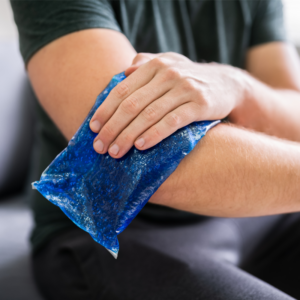
A cold gel pack can temporarily reduce pain after training. It can be used for approximately 10–15 minutes with a layer of fabric between the skin and the cold pack.
Cold therapy is a method for managing symptoms rather than the main treatment. It does not improve the tissue’s ability to tolerate sports load and does not replace an exercise programme.
5. Patellar tendon strap
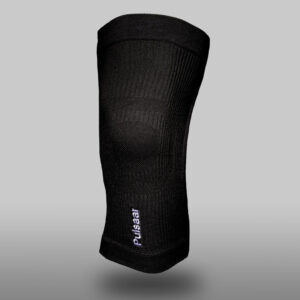
A patellar tendon strap, sometimes called a Schlatter strap, is positioned below the kneecap over the patellar tendon. For some children it may reduce the uncomfortable pulling sensation and make participation in sporting activity more comfortable.
However, an orthosis does not remove the underlying growth-related irritation. It should be used as an adjunct to appropriate load modification and exercise rather than as the only form of treatment.
6. Kinesiology tape
Kinesiology tape may temporarily improve comfort or reduce sensitivity for some children. However, the response is individual, and taping does not replace progressive strengthening and appropriate control of training load.
How long do symptoms last?
Symptoms of Osgood-Schlatter disease can persist for several months and sometimes longer. They may periodically become more noticeable during rapid growth, intensive competition periods or increases in training load.
For most young people, symptoms gradually decrease as the growth area matures. However, it is not realistic to promise that symptoms will always resolve within only a few weeks.
Some people are left with a more prominent bony bump below the knee. In most cases this does not significantly restrict physical activity, although it may remain sensitive during prolonged kneeling. In a small proportion of people, symptoms may persist after skeletal maturity.
When should you see a doctor?
Medical assessment is recommended if:
- pain began after a significant traumatic injury;
- the child cannot properly bear weight through the leg;
- there is marked swelling throughout the knee joint;
- the knee locks or repeatedly gives way;
- there is pain at night or at rest;
- fever, redness or significant warmth develops;
- pain is located somewhere other than the tibial tuberosity;
- symptoms continue to worsen despite reducing physical load;
- pain significantly restricts everyday activities or participation in sport.
These features are not typical of an uncomplicated presentation of Osgood-Schlatter disease and may require further assessment.
When can a child fully return to sport?
Return to sport should not be based only on how many weeks have passed. It should also consider whether the child can perform the movements required by their sport.
Before returning to full training and competition, it is desirable that the child can:
- walk and climb stairs without significant pain;
- perform a squat with good movement control;
- perform a single-leg squat or step-up;
- run, accelerate and decelerate without limping;
- jump and land without significant pain;
- participate in training without a substantial increase in symptoms the following day.
Training load should be increased gradually: first individual exercises, then partial participation in team training and only afterwards full training and competition load.
Summary
Osgood-Schlatter disease is a growth- and load-related condition that most commonly causes pain over the tibial tuberosity below the knee.
The main treatment principles are:
- modifying provocative physical load;
- progressively strengthening the leg and hip muscles;
- improving mobility where it is limited;
- gradually returning to running and jumping;
- educating the child and parents about symptom management;
- using a brace, tape or cold only as additional symptom-management tools.
The prognosis is good for most children, but recovery can take time. If pain is severe, atypical or does not gradually improve, assessment by a doctor or physiotherapist is recommended.
References
Rathleff MS, Winiarski L, Krommes K, et al. Activity Modification and Knee Strengthening for Osgood-Schlatter Disease: A Prospective Cohort Study. Orthopaedic Journal of Sports Medicine. 2020;8(4):2325967120911106. DOI: 10.1177/2325967120911106.
Neuhaus C, Appenzeller-Herzog C, Faude O. A Systematic Review on Conservative Treatment Options for Osgood-Schlatter Disease. Physical Therapy in Sport. 2021;49:178–187. DOI: 10.1016/j.ptsp.2021.03.002.
Corbi F, Matas S, Álvarez-Herms J, et al. Osgood-Schlatter Disease: Appearance, Diagnosis and Treatment – A Narrative Review. Healthcare. 2022;10(6):1011. DOI: 10.3390/healthcare10061011.
Guldhammer C, Rathleff MS, Jensen HP, Holden S. Long-Term Prognosis and Impact of Osgood-Schlatter Disease 4 Years After Diagnosis: A Retrospective Study. Orthopaedic Journal of Sports Medicine. 2019;7(10):2325967119878136. DOI: 10.1177/2325967119878136.
Holden S, Winiarski LM, Krommes K, Thorborg K, Rathleff MS. Is the Prognosis of Osgood-Schlatter Poorer Than Anticipated? A Prospective Cohort Study With 24-Month Follow-up. Orthopaedic Journal of Sports Medicine. 2021;9(8):23259671211022239. DOI: 10.1177/23259671211022239.
Would you like to learn more about knee pain and injuries?
Our complete knee pain and injury guide covers common causes, symptoms, treatment principles and rehabilitation stages – View the complete knee pain and injury guide →
Related Articles
📖 Balance Training – Why Is It Important and How Can You Improve It?
📖 Knee Pain After Sport – What Does the Location of Pain Mean and When Should You Seek Help?
📖 How Should a Knee Ligament Sprain Be Rehabilitated?
Does a Child With Osgood-Schlatter Disease Need to Stop Sport Completely?

Aigars Caune
Physiotherapist
Not necessarily. It is usually more important to reduce movements that significantly aggravate symptoms, such as sprinting, jumping, deep squats and rapid changes of direction.
If the child does not begin to limp, pain does not progressively increase during training and symptoms are not noticeably worse the following day, some physical activity may continue. At the same time, progressive strengthening of the leg and hip muscles and a controlled return to full sporting load are recommended.
Recommended Products


For gymnastics


For gymnastics


Equilibrium surfaces


For gymnastics
Looking for More Practical Physiotherapist Advice?
Visit our Physiotherapist Recommendations section for practical articles about exercise, injury prevention, pain management, load modification, rehabilitation principles and safely returning to everyday activities or sport.
View Physiotherapist Recommendations