






Product reviews
Chattanooga Rehab, Theta, and Physio – a comparison of professional electrostimulators

May
Chattanooga is a professional rehabilitation equipment brand whose products are used in physiotherapy practices, rehabilitation centers, sports medicine , and medical institutions. The brand’s range includes electrotherapy, shockwave therapy, laser therapy, ultrasound, traction therapy, and other rehabilitation devices.
Both Chattanooga and Compex are part of the medical technology company Envis’s brand portfolio, although their main audiences differ. Compex is better known for portable electrostimulation devices for sports, physical fitness, recovery, and home use. Chattanooga, on the other hand, focuses more on medical professionals and clinical rehabilitation equipment.
Fiziopreces.lv range includes three similar but functionally distinct professional Chattanoog electrical stimulators:
All three are portable four-channel stimulators. The main difference lies in the range of available programs and currents, the availability of neurological protocols, Muscle Intelligence technology, and the ability to work with denervated muscles or specific clinical indications.
Who are Chattanooga electrostimulation devices intended for?
Chattanooga Rehab, Theta, and Physio are not just household TENS devices. They are intended for professional work where the physiotherapist needs to adjust the stimulation for a specific patient, diagnosis, and rehabilitation phase.
Depending on the model, it is possible to use:
- TENS for pain relief;
- NMES for muscle activation;
- muscle strength restoration programs;
- Protocols for reducing muscle atrophy;
- muscle re-education;
- circulatory and vascular programs;
- neurological rehabilitation protocols;
- stimulation after knee joint or ligament surgeries;
- specific protocols for stimulating denervated muscles;
- Separate programs for the treatment of edema, hyperhidrosis, and pelvic floor problems.
The choice of specific programs and stimulation parameters depend on the model. Broader functionality does not automatically mean that the most expensive model will be needed for every physiotherapy practice.
How does professional electrical stimulation work?
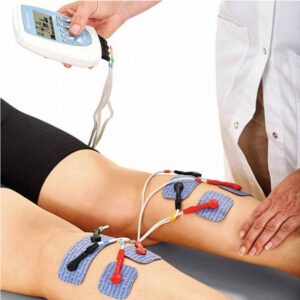
The electrostimulation device transmits electrical impulses through electrodes placed on the patient’s skin. Depending on the chosen program, sensory or motor nerve fibers are stimulated.
TENS for pain relief
The main goal of the TENS program is to create strong yet comfortable sensory stimulation. Visible muscle contraction is usually not necessary.
In a comprehensive systematic review compiling 381 randomized trials and more than 24,000 participants, pain during or immediately after a TENS procedure was less severe than in the placebo group. However, the effect should primarily be perceived as a temporary relief of symptoms rather than treating the cause of the pain.
NMES for muscle activation
NMES, or neuromuscular electrical stimulation, activates motor nerves and causes muscle contraction. It is used when the patient has difficulty fully activating a muscle, for example, during early rehabilitation after knee surgery, prolonged immobilization, or in cases of significant muscle strength reduction.
Research shows that NMES as a supplement to active exercises can improve quadriceps strength recovery after anterior cruciate ligament surgery and knee endoprosthesis, especially in the early rehabilitation period. The result depends on properly chosen parameters and a sufficiently strong but tolerable muscle contraction.
Electrostimulation does not replace active strength training. It is an additional method that can help the patient activate the muscle more effectively and gradually transition to full-fledged active exercises.
Common functions of Chattanooga devices
All three devices have four independent stimulation channels. This allows the simultaneous use of up to four pairs of electrodes and stimulates a larger muscle group or multiple areas.
2+2 function
The 2+2 function allows you to use one program on the first and second channels, and a different program on the third and fourth channels.
In practice, it can be useful to:
- simultaneously combining NMES and TENS;
- stimulate two distinct areas of the body;
- to treat agonist and antagonist muscle groups;
- organize work with two patients if the clinic’s working procedures allow and proper supervision is ensured.
This feature is available on the Chattanooga Rehab, Theta, and Physio models.
Customizing programs
The devices allow you to create and customize programs by changing stimulation parameters that are essential to the patient. This is important in professional practice because the settings of a single pre-prepared program will not always be suitable for all patients.
The physiotherapist must take into account:
- the purpose of treatment;
- stimulated muscle;
- the patient’s sensory abilities;
- rehabilitation phase;
- the desired type of contraction;
- muscle fatigue reaction;
- tolerability of the procedure.
Motor Point Pen
The set includes a Motor Point Pen. This helps to find a spot where the specific muscle can be stimulated with lower current intensity to achieve better contraction.
More precise electrode placement can:
- improve the quality of muscle contractions;
- reduce unnecessary discomfort;
- allow the use of lower intensity;
- to reduce unwanted activation of adjacent muscles.
Finding the motor point is especially important when stimulating the quadriceps, tibialis anterior, gluteal muscles, and other large muscle groups.
Chattanooga Rehab – a basic model for professional rehabilitation
Chattanooga Rehab is a four-channel stimulator designed for physiotherapists and rehabilitation clinics where key TENS, NMES, and vascular stimulation options are needed.
The device has four main standard app categories:
- Rehabilitation I;
- Pain Relief I;
- Vascular Conditioning I;
- standard configurable programs.
Rehab supports muscle activation, pain control, reduction of muscle spasms, promotion of blood circulation, and prevention of muscle atrophy. This is MI-Ready, meaning Muscle Intelligence technology is integrated into all four channels, but the AI cable is not included in the standard package.
Who is Chattanooga Rehab suitable for?
This can be suitable for:
- for a minor private physiotherapy practice;
- for patients undergoing orthopedic and trauma rehabilitation;
- rehabilitation after joint surgeries;
- basic TENS and NMES procedures;
- to activate muscles after immobilization;
- a clinic where complex neurological or denervated muscle protocols are not required.
Rehab is a rational choice when the main patients are people with musculoskeletal system injuries, joint surgeries, pain, and muscle weakness.
Chattanooga Theta – for broader orthopedic and neurological rehabilitation
Chattanooga Theta is the next level after Rehab. It has four standard and four extended program categories:
- Rehabilitation I and II;
- Pain Relief I and II;
- Vascular;
- Neurologic Rehabilitation;
- Conditioning I and II.
Theta is intended for both standard pain and NMES protocols, as well as for more specific rehabilitation. The manufacturer specifically specifies neurological protocols for spasticity, hemiplegic foot, and agonist–antagonist stimulation, as well as protocols after anterior cruciate ligament surgery.
Trigger function
Theta offers a Trigger function that allows the activation of the stimulation phase at the command of a physiotherapist or patient.
It can be useful:
- combining stimulation with the patient’s active movement;
- gait or foot dorsalflexion training;
- neurological rehabilitation;
- in the coordination training of agonists and antagonists;
- reteaching functional movements.
Muscle Intelligence technology
Theta supports four AI functions:
- MI-Scan — assesses muscle response and adjusts impulse parameters;
- MI-TENS — helps regulate TENS stimulation;
- MI-Range — helps determine the appropriate intensity range;
- MI-Action — combines the patient’s voluntary contraction with the initiation of stimulation.
In the standard Theta package, the manufacturer specifies two MI cables.
Who is Chattanooga Theta suitable for?
Theta can be an optimal choice:
- for larger private physiotherapy practices;
- to the sports medicine center;
- working with patients after ACL and other knee surgeries;
- practices that also treat neurological patients;
- functional muscle retraining;
- physiotherapist who requires Trigger and MI-Action functions.
For many orthopedic, sports, and neurological practices, Theta can offer the best balance between functionality and device price.
Chattanooga Physio – the broadest professional functionality
The Chattanooga Physio is the most complete of the three models. It supports standard TENS and NMES, extended neurological and postoperative protocols, as well as specific current types for denervated muscles, edema, hyperhidrosis, and urology needs.
Physio’s range of programs includes:
- Rehabilitation I and II;
- Pain Relief I and II;
- Vascular;
- Neurologic Rehabilitation;
- Conditioning I and II;
- Incontinence;
- denervate muscle programs;
- direct current programs for hyperhidrosis and edema;
- expanded individual program configuration.
Stimulation of denervated muscles
A conventional NMES device stimulates motor nerves, which then activate the muscle. In cases of complete or partial denervation, the situation is different, as nerve conduction can be significantly impaired.
Physio can use longer pulses and specific shapes of current. Its pulse width range reaches 1000 μs, while the maximum pulse width for Rehab and Theta is 400 μs.
The device has an automatic ramp search function in cases of partial denervation. It is designed to find more suitable parameters when it is necessary to stimulate denervated muscle fibers. Such therapy should only be planned by a specialist with appropriate knowledge in electrodiagnostics and denervation muscle stimulation.
Who is Chattanooga Physio suitable for?
Physio can be a justified choice:
- a multi-profile rehabilitation center;
- hospital or outpatient rehabilitation department;
- for neurological rehabilitation practice;
- a specialist working with peripheral nerve injuries;
- a specialist in pelvic floor and urological rehabilitation;
- practices that require direct current or stimulation of denervated muscles.
For a typical private practice that mainly treats back pain, sports injuries, postoperative muscle weakness, and joint problems, not all of Physio’s features may be used regularly.
Comparison table of Chattanooga Rehab, Theta, and Physio
This table can be placed on the product sheets of all three devices.
| Function | Chattanooga Rehab | Chattanooga Theta | Chattanooga Physio |
|---|---|---|---|
| Number | 4 | ||
| Main user | Private practice and standard rehabilitation | Broader orthopedic, sports, and neurological rehabilitation | Multidisciplinary and specialized clinical rehabilitation |
| Program level | 4 standard categories | 4 standard and 4 extended categories | 4 standard, 4 extended, and 3 specialized categories |
| TENS and NMES | Yes | Yes | Yes |
| Vascular programs | Yes | Yes | Yes |
| Neurological programs | limited | Yes | Yes |
| Specific ACL protocols | Within the framework | Yes | Yes |
| 2+2 function | Yes | Yes | Yes |
| Customizing | Yes | Yes | Yes |
| Trigger function | No | Yes | Yes |
| AI technology | MI-Ready; cable not included | Full AI functionality | Full AI functionality |
| Denervated muscle programs | No | No | Yes |
| Automatic ramp search | No | No | Yes |
| Incontinence programs | No | No | Yes |
| DC programs | No | No | Yes |
| Pulse width | 30–400 μs | 30–400 μs | 30–1000 μs |
| Maximum intensity | 120 mA | 120 mA | 120 mA |
| Frequency range | 1–150 Hz | 1–150 Hz | 1–150 Hz |
| The most suitable choice | Basic professional electrotherapy | For universal and extensive physiotherapy practice | For specialized electrotherapy and complex patients |
The technical specifications of the models and their functional distribution are based on Chattanooga’s official product information.
Which Chattanooga model to choose?
Choose Chattanooga Rehab if:
- you mainly work with orthopedic patients;
- TENS, NMES, and vascular programs are required;
- there is no regular need for neurological protocols;
- you want a professional yet relatively simple model;
- You plan to add AI technology only when necessary.
Choose Chattanooga Theta if:
- There are many different types of patients in practice;
- you work with sports injuries and postoperative rehabilitation;
- necessary ACL and neurological rehabilitation protocols;
- you want Trigger and MI-Action functions;
- A universal model without very specific DC programs is required.
Choose Chattanooga Physio if:
- Stimulation of denervated muscles is required;
- working with peripheral nerve damage;
- urology or pelvic floor programs are necessary;
- use direct current for treating edema or hyperhidrosis;
- The device is intended for a multi-profile rehabilitation center.
Chattanooga or Compex – which to choose?
Compex devices are generally more suitable for individual users, athletes, or patients who will use specific pre-prepared programs at home, in the gym, or in a team environment.
Chattanooga Rehab, Theta, and Physio are more suitable for a healthcare specialist who needs:
- four independent channels;
- individually customizable parameters;
- multiple patient and diagnosis protocols;
- more detailed professional control;
- neurological and postoperative programs;
- the possibility to combine different types of stimulation.
Both brands are part of Enovis, and both use related electrostimulation and Muscle Intelligence technologies. The intended user and work environment of the devices differ: Compex mainly focuses on sports and individual use, while Chattanooga focuses on clinical rehabilitation and medical specialists.
Does a professional device automatically provide better results?
Not always. The device’s functionality offers more possibilities, but the treatment outcome is also determined by:
- correct indication;
- an appropriate program;
- precise electrode placement;
- appropriate intensity;
- patient tolerance;
- the time of the procedure;
- combining electrostimulation with active exercises.
For example, a quadriceps NMES procedure with too low intensity can produce visible muscle movement but not provide strong enough contraction to improve strength. Better results in studies after knee surgeries are generally associated with sufficiently intensive stimulation combined with structured rehabilitation.
Safe use in professional practice
Before using the device, assess the patient’s health condition, diagnosis, sensation, and the purpose of the procedure. The indications, contraindications, and precautions specified in the instructions for the specific Chattanooga model must be observed.
Electrodes should not be placed on damaged or infected skin, the front part of the neck, or in a way that allows the electrical path to cross the chest. Special caution is required for patients with implanted electronic devices, epilepsy, pregnancy, sensory disturbances, or symptoms of unclear origin.
A professional device allows changing more parameters, so the user needs knowledge of pulse width, frequency, work-rest ratio, ramp, polarity, and tissue response. Specific denervated muscle and DC programs should not be used as regular automated programs without appropriate patient assessment.
Frequently asked questions about Chattanooga Rehab, Theta, and Physio
Is it possible to later supplement Chattanooga Rehab with AI technology?
Yes. Chattanooga Rehab is MI-Ready, which means Muscle Intelligence functions are integrated into all four channels, but the AI cable is not included in the standard package. It can be purchased separately if there is a practical need later to use MI-Scan, MI-TENS, MI-Range, or MI-Action features.
What does the Chattanooga 2+2 feature practically allow you to do?
The 2+2 function allows you to use one program on the first and second channels, and a different one on the third and fourth channels. For example, a physiotherapist can use NMES in one area of the body to activate muscles while simultaneously using TENS for pain control in another area. This option is available on the Rehab, Theta, and Physio models.
Why does the set include a point-finding pencil in the engine?
The Motor Point Pen helps find the spot where the specific muscle can be most effectively stimulated. A more precise electrode placement can achieve a smoother contraction with less current intensity and less discomfort for the patient. All three models have a corresponding motor spot finder function and a pencil.
What is the difference between the Theta Trigger function and MI-Action?
With the trigger function, the therapist or patient begins the stimulation phase by pressing a button. In turn, MI-Action uses a voluntary muscle contraction recognized by the device to initiate stimulation. These options can be useful in functional and neurological rehabilitation when stimulation needs to be precisely linked to the patient’s active movement.
Is Chattanooga Theta intended only for sports injuries?
No. Theta includes not only postoperative and sports rehabilitation programs but also protocols for neurological patients, including training for spasticity, hemiplegic foot, and agonist–antagonist muscle function. This makes Theta suitable for multidisciplinary physiotherapy practice, not just for work with athletes.
Why is Chattanooga Physio necessary for stimulation of denervated muscles?
Regular NMES programs mainly stimulate motor nerves. In cases of denervation, nerve conduction can be impaired, so more specific current parameters and a longer pulse width are necessary. Chattanooga Physio offers pulses up to 1000 μs and automatic ramp detection in cases of partial denervation; Rehab and Theta pulse bandwidths are up to 400 μs.
Are Physio’s specialized programs necessary for every private practice?
Not necessarily. While the practice mainly treats musculoskeletal pain, sports injuries, and patients after joint surgeries, Rehab or Theta often provides the necessary TENS and NMES capabilities. Physio’s broader functionality is more justified in practices where denervated muscles, peripheral nerve injuries, pelvic floor problems are regularly treated, or specialized direct current programs are used.
Can the Chattanooga professional electrostimulator be given to the patient for home use?
These devices are primarily intended for physiotherapists and rehabilitation clinics. The patient should only be allowed to use them at home after the specialist has selected the program, adjusted the parameters, demonstrated the electrode placement, and explained the safety conditions. The complex neurological, denervation, and DC programs are not suitable for independent trial without professional supervision.
Can a physiotherapist create their own app on a Chattanooga device?
Yes. Rehab, Theta, and Physio support the creation of programs and parameter adjustments to the specific needs of each patient. This allows adjusting the parameters of stimulation according to the treatment goal, but such programming requires understanding of frequency, pulse range, work-rest relationships, and the patient’s response to stimulation.
Summary
Chattanooga Rehab, Theta, and Physio are professional four-channel pacemakers designed for physiotherapists and rehabilitation clinics.
Chattanooga Rehab provides core TENS, NMES, vascular, and rehabilitation programs. It is suitable for private practice with predominantly orthopedic and postoperative patients.
Chattanooga Theta offers broader neurological, sports, and postoperative capabilities, trigger functionality, and fuller use of AI technology. For many physiotherapy practices, this will be the most versatile model.
Chattanooga Physio is additionally intended for stimulation of denervated muscles, urology, incontinence, edema, and hyperhidrosis therapy. It is most suitable for multidisciplinary or specialized rehabilitation facilities.
When choosing a device, the most important thing is not the maximum number of programs, but whether the specific functions correspond to practice patients and will actually be used in daily work.
References
Enovis. Chattanooga Rehabilitation Equipment.
Chattanooga. Rehab – Product Information and Technical Specifications.
Chattanooga. Theta – Product Information and Technical Specifications.
Chattanooga. Physio – Product Information and Technical Specifications.
Johnson M. I., Paley C. A., Jones G. et al. Efficacy and safety of transcutaneous electrical nerve stimulation for acute and chronic pain in adults: the meta-TENS study. BMJ Open. 2022; 12:e051073.
Li Z., Jin L., Chen Z., et al. Effects of Neuromuscular Electrical Stimulation on Quadriceps Femoris Muscle Strength and Knee Joint Function in Patients After ACL Surgery. Orthopaedic Journal of Sports Medicine. 2025; 13(1).
Labanca L., Bonsanto F., Raffa D., et al. Does adding neuromuscular electrical stimulation to rehabilitation following total knee arthroplasty lead to better quadriceps strength recovery? International Journal of Rehabilitation Research. 2022; 45(2):118–125.
Related articles
📖 TENS therapy for pain relief – how to use it safely and effectively?
📖 Compex electrostimulation devices – comparison of FIT and SP models
📖 NeuroTrac pacemakers – comparison of TENS, REHAB, MultiTENS, SPORTS XL, and Continence
📖 TENS and EMS electrode placement – a practical guide for different body zones
Which Chattanooga electrostimulator should you choose for a new private physiotherapy practice?

Aigars Caune
physiotherapist
If orthopedic, postoperative, and pain patients will predominantly be in practice, Chattanooga Rehab will typically provide the necessary basic functions. Theta is more suitable when planning to work with athletes, ACL rehabilitation, and neurological patients. The purchase of Physio is most justified when denervated muscle, urological, or coaxial therapy is regularly required in practice.
Recommended Products

Electrical stimulation

Electrical stimulation

Electrical stimulation

Electrical stimulation
More articles about product reviews
Interested in more information about various physiotherapy products? Check out our product overview section, where you will find articles about gymnastics, lymphatic drainage therapy, fascia massage, and other products.
Read more