






Physiotherapist's recommendations
Acupressure mat: benefits, uses, and contraindications
Aug
After a long workday, your shoulders and back may feel tense even if you haven’t done physically demanding work. Prolonged sitting, stress, training load, and insufficient recovery often create a desire for a simple way to relax for a moment and reduce discomfort.
An acupressure mat, or needle mat , is one of the self-care products used for relaxation and superficial mechanical stimulation of the skin. For some people, this may temporarily reduce the intensity of neck or back pain and help them relax, but the amount of evidence is currently limited. The mat does not replace diagnostics, treatment, regular movement, or physiotherapist-led rehabilitation.
Moreover, acupressure at home is not limited to just mats. Also available are needle rollers, acupressure pillows, and other applicators that help stimulate smaller or harder-to-reach areas of the body. Therefore, in this article, we explore not only the benefits and proper use of acupressure mats but also how different acupressure tools differ and which option to choose for a specific purpose.
What is an acupressure mat and how does it work?
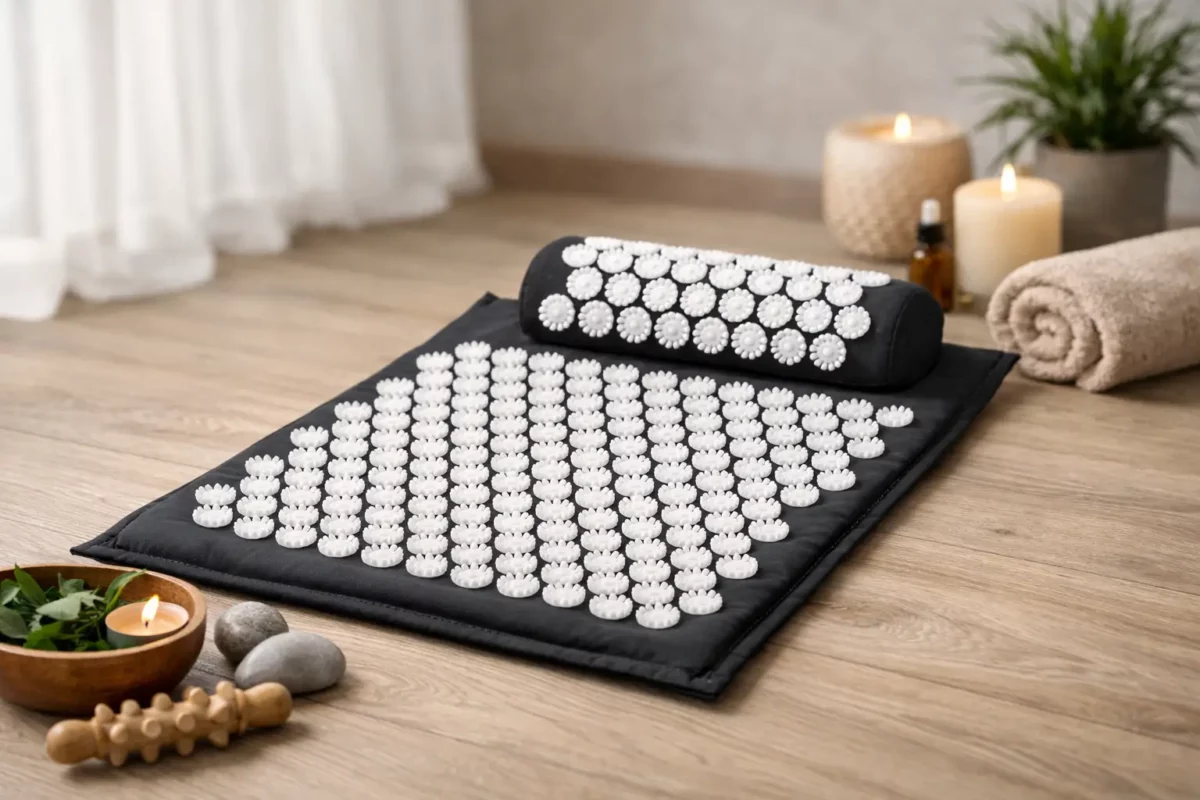
An acupressure mat is a surface with many small applicators that evenly distribute mechanical pressure on the skin. Depending on the design, applicators can be made of plastic or metal elements placed on a flexible base. In everyday language, such products are often also called “needle mats,” but they are not the same as acupuncture.
In acupuncture, the specialist inserts fine needles at specific points, while the purpose of the acupressure mat or roller is to create superficial mechanical stimulation over a larger area of the skin. When used correctly, the applicator is not intended for controlled needle insertion into tissues.
In the first few minutes, the sensation may be sharp and unusual, especially if the mat is used on bare skin or hard surfaces. After a few minutes, for many people, the sensation becomes more tolerable and may shift into sensations of warmth, pulsation, or relaxation. The exact mechanism by which an acupressure mat affects pain and well-being is not fully understood. Most likely, intensive stimulation of skin receptors, shifting attention away from usual pain sensations, and the relaxation process itself are all important.
It is important to maintain realistic expectations. The acupressure mat does not cure a herniated disc, does not “dissolve” muscle knots, or does not restore a damaged ligament or tendon. Its value is rather as a complementary self-care method alongside regular movement, sleep, exercise planning, and specialist-recommended therapy.
What do studies show about acupressure mats?
There are not many studies on acupressure mats, so they should not be attributed a broad therapeutic effect. However, there is some interesting data on improvements in short-term pain and well-being.
A small randomized pilot study included people with chronic neck or lower back pain. Participants regularly used a mechanical needle stimulation mat for 14 days. Compared to the standby control group, mat users reported a greater reduction in pain intensity. In the neck pain group, function related to neck pain also improved, while in the back pain group, no significant improvement was observed in the functional score.
These results should be interpreted cautiously: the study was small, a pilot study, and no convincing placebo mat was used for comparison. Therefore, a single study cannot conclude that an acupressure mat treats the cause of chronic pain or is better than active physiotherapy.
In another study published in 2024, healthy individuals performed a relaxation workout for three weeks using an acupressure mat or without additional equipment. Several subjective well-being indicators improved in both groups, but the mat group did not show a clear superiority over a typical relaxation routine. This well illustrates a practical conclusion: part of the benefit may be related to the quiet rest itself, not just the mat.
What can be the benefits of an acupressure mat?
The benefit can vary for each person. It is influenced by the cause of the pain, pressure sensitivity, the surface used, the duration of use, and the overall daily load. Most often, acupressure mats should be seen as a temporary means of self-care and relaxation, rather than treatment for a specific diagnosis.
Reducing the sensation of muscle tension
A mat can be pleasant if the neck, shoulder girdle, or back muscles feel stiff after working at a computer, driving, or monotonous exertion. Lying down and evenly distributed pressure help some people reduce tension and make them feel more relaxed for a moment.
If the feeling on the floor is too intense, the mat can initially be placed on the bed or sofa, where the body weight in the applicators is less absorbed. Another option is to use a thin cotton shirt between the skin and the mat.
Relaxation routine before sleep
For some people, 10–20 minutes on the mat helps them switch from an active day to a calmer evening rhythm. It is not a specific treatment for insomnia, but a regular evening ritual without phones, work messages, or other distractions can help you relax on its own.
If the sensation of the mat activates you rather than calms you, there is no need to force yourself to use it right before going to bed. This can be used earlier in the day or another form of relaxation can be chosen.
Well-being after physical exertion
After training, an acupressure mat can complement cooling, gentle mobility, walking, or breathing exercises. This can be enjoyable for people who feel fatigue in the upper back, gluteal muscles, or feet after training.
However, in the case of a fresh injury, intensive mechanical stimulation directly in the painful area is not a priority. In the first days after a sprain, bruise, or muscle tear, it is more important to assess the severity of the injury, adjust the load, and gradually restore movement.
A simple way to take a short self-care break
The mat does not require electricity, complicated installation, or special skills. It can be used at home and taken along on trips. This simplicity is one of the main advantages, but it doesn’t mean you should ignore the body’s signals. Sharp, increasing, or radiating pain is not a goal to be “endured.”
How to properly use an acupressure mat?
The first time, there is no need to try to prove endurance. Start with about 5–10 minutes and choose a softer surface or a thin layer of clothing between the skin and the mat. When the sensation becomes acceptable, the duration of use can be gradually extended. For many people, 15–30 minutes is enough, but a longer procedure does not automatically mean better results.
Always follow the specific manufacturer’s usage instructions, as the shape, sharpness, distance, and material of applicators vary for different products.
Use on the back
Place the mat on a flat surface and lie down slowly so that the body weight is evenly distributed. If the feeling is too sharp, use a softer base or a thin shirt. There is no need to move or rub your back against the applicators.
Use on the neck
A small acupressure pillow, a rolled-up towel under a mat, or an applicator of the appropriate size can be more comfortable for the neck area. The neck position should be comfortable. If dizziness, headache, tingling, or radiating sensations in the hands occur, use should be discontinued.
Use on the feet
At first, it is safer to stimulate the feet while sitting by monitoring how much body weight is transferred to the applicators. Later, if the sensation is well tolerated and there are no sensory disturbances, the pressure can be gradually increased.
After the procedure, rise slowly. A brief, even skin redness can occur after mechanical pressure, but prolonged burning, bleeding, severe bruising, skin damage, or numbness are not the desired outcome.
Acupressure is not just a mat – how do different tools differ?
If the category of acupressure is perceived only as “back mats,” part of its practical application is missed. Various tools allow you to adjust the stimulation area, the pressure intensity, and whether the procedure is static or dynamic.
| Acupressure tool | How is it used? | Where could it be more practical? |
|---|---|---|
| Acupressure mat | They lie on it or support a controlled part of the body. | For the back, shoulder girdle, gluteal area, feet, and relaxation routine. |
| Medium-sized needle roller | Move the roller over the skin, adjusting the pressure by hand. | For smaller and curved areas – shoulders, arms, lower legs, feet. |
| Large roller of | Dynamically treats a larger surface area. | For the back, thighs, and other larger muscle areas. |
| Acupressure pillow or local applicator | Place it under a specific area of the body. | The neck, lower back, or another smaller area where a full mat is not necessary. |
Fiziopreces.lv acupressure section currently offers LYAPKO acupressure mats, various sizes of needle rollers, a larger LYAPKO roller , and a BLACKROLL NEEDLE ROLLER. As the range expands, the selection principle remains the same: first, determine which body area you want to stimulate and whether you want static relaxation or dynamic self-massage.
A mat or a roller of needles – which one to choose?
If the main goal is to lie down, relax, and at the same time stimulate a larger back area, an acupressure mat is usually more practical. It does not require active manual labor and allows the pressure to distribute over a larger area.
If you want to control your pressure more precisely or treat a smaller area, such as the shoulder, forearm, calf, or thigh, a needle roller may be more convenient. With the roller, pressure can be adjusted during movement, making it easier to adapt the procedure to a specific zone.
There is no single “most effective” acupressure product for everyone. The best option is one that you can use regularly, comfortably, and without excessive skin irritation.
Possible contraindications and precautions
The acupressure mat and roller are not suitable for use on all body areas or in all health situations.
Do not use the acupressure tool directly on:
- open wounds or fresh skin lesions;
- burns;
- active dermatitis or pronounced rash;
- skin infections or fungal infections;
- Severely swollen and acutely injured areas;
- areas where pressure causes sharp or radiating nerve-type pain.
Additional caution is required for people with coagulation disorders, a pronounced tendency to bruise, or the use of blood-thinning medications. In such cases, it is worth consulting a treating specialist before regular intensive use.
If you have diabetes-induced sensory disturbances, peripheral neuropathy, or another condition where the ability to feel pain, pressure, or temperature is reduced, acupressure tools should not be used without professional advice. Reduced sensation makes it harder to notice excessive irritation or skin damage in time.
During pregnancy, after recent surgery, during active oncology treatment, in case of severe vascular disease or unexplained pain, it is advisable to consult a doctor, midwife, or physiotherapist who understands the specific health condition before use.
Discontinue use if dizziness, nausea, severe burning, numbness, bleeding, or significantly worsening pain occurs.
If back or neck pain is accompanied by progressive muscle weakness, severe numbness, changes in urine or bowel movements, fever, a recent serious injury, or a rapid deterioration in general well-being, medical evaluation is the priority rather than self-care with a mat.
The most common mistakes when using an acupressure mat
1. Start immediately with maximum pressure
Stronger pain does not mean a better effect. If the first time you lie down immediately on a hard floor with a bare back and try to hold it out for 30–40 minutes, you are more likely to get unnecessary skin irritation than better results.
2. Consider skin imprints as the goal of treatment
A brief redness is an understandable reaction to mechanical pressure, but very pronounced feet, bruises, or skin damage are not signs that the procedure was “more effective.”
3. Use the mat directly on fresh injuries
A fresh sprain, muscle tear, bruise, or a severely swollen area is not a suitable place for aggressive mechanical stimulation. During the acute phase, it is more important to assess the injury and determine an appropriate exercise regimen.
4. Replace movement and exercise with a mat
If your back regularly hurts after sedentary work or physical exertion, short-term relaxation can be pleasant, but in the long term, you should also consider the amount of movement, working postures, strength, sleep, and load planning. An acupressure mat can be a complement, not the only strategy.
5. Neglecting hygiene
Regularly clean the mat or roller according to the manufacturer’s instructions. If there are rashes, infection, or damage on the skin, do not use or share the product with another person.
How to choose an acupressure product that suits you?
The first question is not “which product has the most needles?”, but rather what purpose you want to use it for.
If you want to relax your entire back, choose a sufficiently large mat. If the main area is the neck or lower back, consider a product that can be adjusted to the body’s curve. If you want to control the pressure on your shoulder, thigh, calf, or another small area yourself, a needle roller might be more practical.
Pay attention:
- the size of the product;
- the shape and spacing of the applicators;
- materials and care options;
- how easily the pressure can be adjusted;
- the body area where you plan to use the product;
- manufacturer’s instructions for use and safety.
If you are very sensitive to pressure, start with gentler application rather than automatically looking for the “sharpest” mat. On the other hand, an experienced user may find it more important to precisely stimulate specific areas with a roller or another local applicator.
Can an acupressure mat be used every day?
If the skin is healthy, the feeling is comfortable, and there is no lasting irritation after use, many people use the mat regularly. There is no need to increase either the pressure or the duration of the procedure every day. The most important factor is a tolerable, predictable reaction.
If the skin remains painful, bruises appear, or symptoms worsen the day after use, reduce the pressure, duration, or frequency of use. If the problem recurs, the specific product or how to use it may not be suitable for you.
Summary
An acupressure mat can be a simple self-care tool for relaxation and temporary relief from pain or muscle tension. Small studies show a possible benefit for chronic neck and back pain, but the evidence base remains limited and does not allow the mat to be considered a treatment for a specific diagnosis.
The mat is best suited for a larger body area and passive relaxation, while the needle roller allows for more precise pressure regulation and dynamic stimulation of smaller zones. Regardless of the chosen product, start gradually, observe the skin’s reaction and the specific product usage instructions.
If the pain persists, recurs, or is accompanied by numbness, weakness, radiating pain, or other unusual symptoms, it is more important to identify the cause of the problem rather than increase the intensity of acupressure.
References
Hohmann C, Ullrich I, Lauche R, et al. The Benefit of a Mechanical Needle Stimulation Pad in Patients with Chronic Neck and Lower Back Pain: Two Randomized Controlled Pilot Studies. Evidence-Based Complementary and Alternative Medicine. 2012;2012:753583.
Kisker J, Schöne B. Regular use of acupressure mats reduces perceived stress at subjective but not psychophysiological levels: Insights from a three-week relaxation training. Applied Psychology: Health and Well-Being. 2024; 16(1):338–355.
Related articles
📖 Sports massage before and after training: what is the difference?
📖 Fascia roller – benefits, uses, and common mistakes
📖 BLACKROLL products – fascia rollers, balls, and massage tools
📖 Massage ball: how to choose and use it correctly?
Can an acupressure mat replace exercise for back pain?

Aigars Caune
physiotherapist
No. An acupressure mat can be a pleasant way to temporarily relieve feelings of tension or pain and introduce a relaxation break, but it does not improve strength and by itself does not increase the back’s tolerance to daily load.
If a person’s back regularly hurts after sitting or physical work, I would rather use a mat as a supplement for movement, exercise, and load adjustment. If the pain intensifies, radiates to the arm or leg, numbness or loss of strength appears, it is more important to undergo a professional evaluation.
Recommended Products


Acupressure


Acupressure


Acupressure


Acupressure
Interested in more practical physiotherapist advice?
Check out our physiotherapist’s recommendation section, where you will find articles on exercise, injury prevention, pain relief, load adjustment, rehabilitation principles, and a safe return to daily activities or sports.
Check out the physiotherapist's recommendations